
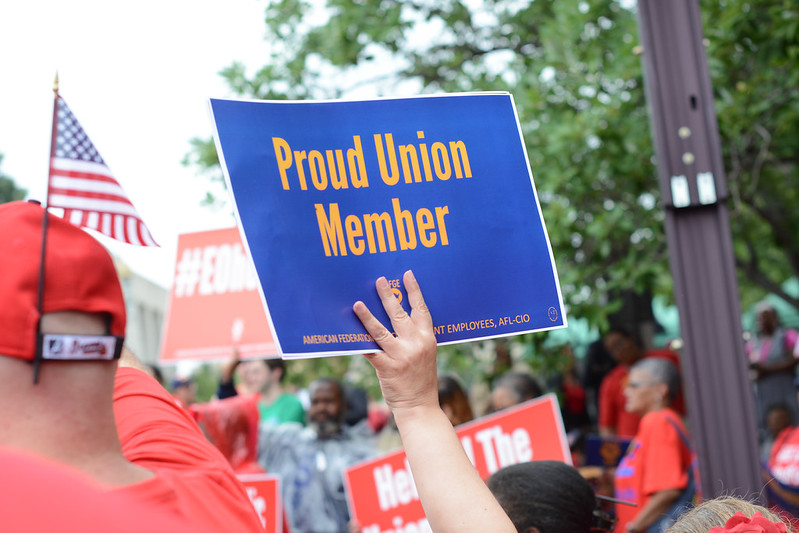
A Collage of Reporting from Pacifica Network's LIVE Coverage of May Day.
Protesters in Paris, farm workers in Florida, musicians in New York, and teachers in Little Rock speak their worth and point of view.
Here are a collage of voices from May Day, a day of solidarity of workers, educators and communities.
In France, May Day is celebrated as a public holiday.
From KPFA (Berkeley)
In 320 cities across France, hundreds of thousands of people took to the streets to mark International Workers Day. Nobody works in France on the day. Most businesses are closed. The only exceptions are essential workers, restaurants and hotels, and industries which require round the clock attention, like nuclear power plants. Even bakeries are mostly shut down.
Dorothee Schaefer (KPFA in Paris)
In France, Workers Day has been celebrated in its current form on May 1 since 1947 and is the only public holiday where employees are legally obliged to be given paid leave. While workers and labor activists claim the holiday as a day of rest, protest and labor mobilization, recurring debate has arisen around certain professions such as bakers and florists that are not strictly essential workers but which play a role in daily life and face significant challenges as a result of the closures. Bakeries are a daily staple food for French people, and the First of May is also Muguet day which is celebrated by the gifting of lilies of the valley as a wish for good fortune.
Recently, the government of President Emmanuel Macron joined forces with far right lawmakers to try to change the law and allow work on May Day. Trade unions have opposed the move, arguing it would force around 1.4 million people to work on a day that is symbolically dedicated to workers. This year, the government said it ‘wants bakeries and florists to be able to open’ but under certain conditions. The message has resulted in confusion with some shops taking the comment as permission to open while others feared fines as some shops were penalized for opening on May Day last year. So far, no fines have been reported.
Gregory Luca runs a bakery and said his employees were in favor of working on the holiday.
Gregory Luca/translated
This year, we got the authorization from the Prime Minister to make our employees work on May 1 but only if they want to. In fact, everyone wants to work because I pay them double. Last year, I opened my business without any employees, so I had to work all night. We make a lot of money on May 1 because supermarkets are closed, so we have lots of clients.
Dorothee Schaefer
Another aspect of May Day is the workers’ protest. In central Paris, the atmosphere is festive, and the demands are internationalist. [Workers chant,] ‘Revolution Emergency. And, we shout, Solidarity among the Exploited, the Oppressed and the Workers of the entire world. No countries, no borders, only one working class.’
The march in Paris was organized by the General Confederation of Labor Unions or the CGT who said that it is part of the group’s identity to be confrontational and comfortable with street mobilization. Mohammed Dior is with the CGT. He said their call for this year’s March is, ‘We do not touch May 1.’
Mohammed Dior/translated
The government is trying to take our public holidays away from us, but the CGT union demands that May 1 remains a paid holiday for everyone.
Dorothee Schaefer
Amnesty International also took part in the march and said that this year it is focusing on immigrant workers’ rights. Jean-Claude Samouiller is the President of Amnesty International France.
Jean-Claude Samouiller/translated
This year, we are putting an emphasis on the problems faced by foreign workers with getting their work papers renewed each year. It’s become extremely hard to get an appointment with the administration, and the cost of the application has risen to 225 euros. They can lose their jobs and become illegal due to the slow response of the administration.
Dorothee Schaefer
Residents in the march were protesting for more than just labor rights. A wide variety of issues were being championed, including queer rights, the rights of the Tamil people in Sri Lanka, the situations in Palestine, Cuba, Ukraine, and the plight of Kurdish immigrants. It was also at times anti-capitalist, against the far right and against the current French Cabinet.
Cecile is with Urgence Palestine, a French pro-Palestinian collective founded by Palestinians in exile and their allies to mobilize against Israeli military actions in Gaza.
Cecile/translated
We are part of an organization called Urgence Palestine. We are on war against war. We fight today against imperialism, militarization. All our comrades have cases, and we are very committed with Palestine because it has to do with everything that is happening today.
Protesters joined from around the world. Anna is from San Francisco, California, and noted the difference between protests in France and the United States.
Anna
I’m part of a collective through my housemates called the People’s Want, and we’re here to support the workers.
Dorothee Schaefer
Are you able to compare the protests in San Francisco and the protests in Paris?
Anna
I would say it’s much more grassroots here than in San Francisco. San Francisco is quite like a production. It’s like permits, and it feels more rehearsed than in Paris, if that makes sense.
Dorothee Schaefer
Union organizers say they counted roughly 300,000 participants across France and 100,000 protesters in Paris alone. Police sources reported numbers a quarter of that size. No violent event has been reported. The police stayed in the back streets with their vehicles and didn’t interfere in the march.
The documentary Without Shade, Without Rest illustrates how farm workers in Florida are exposed to extreme temperatures. Workers and activists including We Count! and The Coalition of Immokalee Workers are fighting for legal protection. The film, WMNF’s Juanita Hurtado Huerfano reports, has been making the rounds across Florida including opening the May Day demonstration in Coral Gables.
From WMNF (Tampa Bay)
Juanita Hurtado Huerfano (WMNF)
The documentary begins with the Miami Dade death due to heat stroke of farm worker Jose Delgado. That inspired the campaign Que Calor! pushed by the organization We Count!. Claudia Navarro, co-director of We Count!, spoke at the screening in Tampa.
Claudia Navarro
The workers are at the forefront facing climate adaptation. I think all of these crises are compounding. We’re not just talking about a worker who experiences extreme heat outdoors. What happens when he goes home, or they go home, and they don’t have air conditioning because their landlord doesn’t care enough to repair it? What happens when your body, over a long period of time, can’t cool down?
Juanita Hurtado Huerfano
The film then follows We Count!’s fight for a county-wide heat ordinance in Miami Dade which stalled in 2024 when the Florida Legislature passed a preemptive bill. The bill banned local municipalities from imposing any heat regulations. We Count! partnered then with the Coalition of Immokalee Workers which had developed the Fair Food Program. It works as a contract between big ripple companies like Walmart and farm workers. Companies agree to only buy produce from farmers and industries that abide by the heat regulations, worker protections and Code of Conduct set by the Coalition. These include water, shading and heat breaks when temperatures go above 90 degrees.
Claudia Navarro
To die of extreme heat is 100% preventable.
Juanita Hurtado Huerfano
For Lupe Gonzalez, the Fair Food Program is about righting the historical abuse of agricultural workers.
Lupe Gonzalez/translated by Marcos Martins
As workers, we have seen and we have been victims of abuses such as wage theft, sexual harassment and even, in extreme cases, modern day slavery in the agriculture industry.
Juanita Hurtado Huerfano
They currently have agreements with 14 retail companies, many of which were achieved through protests and boycotts over the course of 14 years. We Count! and the Coalition of Immokalee Workers are pushing for increased protections in the plant nursery industry. Last Friday, We Count! participated in the National May Day demonstration.
Board Member and plant nursery worker Alejandro Perez Gonzalez spoke at the protest.
Alejandro Perez Gonzalez/translated by an attendee
A day like today, a movement was filled under the slogan, ‘Eight work hours, eight hours of leisure and eight hours of rest.’ Those workers sought to put an end to their abuse and mistreatment. Sadly, 140 years later, we are still in the street with some of the same demands.
Juanita Hurtado Huerfano
According to We Count!, Florida produces 70% of the country’s indoor foliage, making it a $50 billion industry that relies mostly on immigrant labor with very few protections.
Alejandro Perez Gonzalez/translated
Behind these beautiful plants lies a very different reality. In many plant nurseries, we, the workers, are enduring an immense amount of suffering. We work under extreme heat without being allowed to drink water. They don’t pay us enough. Our lunch breaks are not respected and we go hungry. We are forced to work shifts lasting more than 10 hours. We suffer from wage theft, intimidation and even retaliation. This is the sad reality for thousands of nursery workers, but we know that we are essential and we deserve respect. Without us, these companies would not have a single dollar. Without us, there would be no plant in any of these stores. Where would they make their profits without the labor of our hand?
Juanita Hurtado Huerfano
The campaign pushes for what they call a worker-driven social responsibility model. It aims for retailers like Ikea, Whole Foods, and Home Depot to sign agreements similar to those developed by the Fair Food Program that guarantee independent enforcement and a worker-created code of conduct. To learn more about the campaign, you can visit ‘we-count.org/plantingjustice.’
From WBAI (New York)
Jeannie Hopper (Pacifica Network News)
We love our music, but far fewer of us think about what it actually takes for the people who make it to survive. Beneath the playlist and polished platforms, independent musicians are being squeezed, caught in the tectonic shifts of the gig economy, paid fractions of a penny by streaming giants like Spotify, and facing a new wave of disruption from artificial intelligence or AI. And, unlike many other workers, most independent musicians have little to no union representation, leaving them with even less power to negotiate fair pay or protect their work. For many artists, this isn’t just an industry shake- up. It is a fight against starvation wages and for the future of creative labor itself.
But musicians aren’t staying quiet. They’re organizing. I spoke with musician and activist Mark Ribot, a founder of the Music Workers Alliance (MWA) based in New York, about their ‘We Need a Union’ campaign and what it will take to win real protections, a seat at the bargaining table and an industry where music workers can actually live with dignity.
Jeannie
What is the Music Workers Alliance?
Mark Ribot
Music Workers Alliance is a worker center for indie musicians. The mission is to empower indie musicians through collective action which includes union-type action. And the ‘We Need a Union’ campaign is a joint campaign of MWA and the Austin Texas Musicians Organization which was formed around the immediate need to do something about AI but also around the more general need to create a union for independent musicians.
Jeannie Hopper
One of the points of action in the MWA ‘We Need a Union’ campaign is targeting streaming services.
Mark Ribot
The switch to streaming has been pretty much a disaster for musicians. Spotify is .0038 cents a stream, a starvation wage. There’s a few that are better but not by much. And Spotify is kind of unavoidable as it has something like 700 million users and it’s international.
Jeannie Hopper
There is a legislative push championed by United Musicians and Allied Workers and supported by MWA to take on streaming starvation wages. But, as Mark Ribot makes clear, that’s a long road and only part of the story.
Mark Ribot
The terrible streaming rates are not entirely caused by the streaming services. It turns out that nobody can actually sell what anybody can readily get for free, and so the cause for that distorted market, for the devaluation of music, is YouTube and the other corporations that have benefited by presenting music largely without the pay or the consent of the artist. So why have they been able to get away with it? I don’t want to get too into the weeds, but there’s a law called Section 512 of the Digital Millennium Copyright Act, Safe Harbor, an exemption from liability. The onus is on the user which is effectively unenforceable. Let’s just say that the political cards are not lined up to change that at the moment.
Jeannie Hopper
Mark Ribot also emphasized the importance of collective action and the potential for unionization to improve working conditions and wages in the gig economy. Mark Ribot then went on to highlight the need for legislation like the Protect Working Musicians Act introduced by Representative Deborah Ross of North Carolina’s Second Congressional district.
Mark Ribot
Right now, the Protect Working Musicians Act would be very important. It would enable us to negotiate with platforms like Spotify and with AI companies. It would enable us to negotiate directly with them. Right now we can’t because we don’t have a direct relation with them economically. They don’t hire us, and we don’t have a voice. And it’s not just that we don’t have a voice. Everybody knows that several rock stars have withdrawn their material from Spotify and spoken out publicly; but what no one has asked is why didn’t they all get together and do it collectively. We could have really won stuff. And the answer to that question is something most people don’t know. If Taylor Swift had asked Neil Young, both of whom protested separately at different times, if Taylor Swift had asked her friends to get together and join her boycott, she would have been in violation of Federal Labor law. They could have taken everything she ever made, everything she ever will make. They could have placed a gag order on her if she insisted on speaking out about it. They could have imprisoned her. So that’s Taft Hartley.
Jeannie Hopper
The Taft Hartley Act enacted in 1947 weakened musicians’ unions like the American Federation of Musicians (AFM) by limiting their ability to pressure venues and protect jobs; and, over time, it helped push many working artists into being classified as independent contractors instead of employees. For indie musicians, that’s meant less bargaining power, fewer protections and a much harder path to organizing for fair pay, despite earlier gains won under leaders like James Petrillo, AFM’s President, whose aggressive strikes in the 1940’s secured royalties for musicians.
Mark Ribot
That’s what we need to work around. That’s what sooner or later there needs to be (sooner would be better), legislation to give work, to restore workers’ rights to organize. The Protect Working Musicians. Act does that for musicians in the limited but very important area of streaming platforms and AI companies.
Jeannie Hopper
You can find out more about Music Workers Alliance, their ‘We Need a Union’ campaign and more at musicworkersalliance.org
From WBAI (New York)
In New Orleans, Emily Blau is a nurse on the picket line. She is an RN at the University Medical Center (UMC) Neurological Intensive Care Unit (Neuro ICU).
Jeannie Hopper
Can you explain to everybody where you are?
Emily Blau
We are out on the picket line for a sixth time on the corner of Canal and Galvez in downtown New Orleans, outside University Medical Center. We issued an unfair labor practice against the hospital, a charge, and we’re on strike today in opposition to the kind of surface bargaining we’ve been dealing with with the hospital since we started negotiations two years ago for our first contract.
Jeannie Hopper
Can you tell us a bit about University Medical Center and its significance with regard to the community at large?
Emily Blau
So UMC is right in the heart of New Orleans. It’s a Level One Trauma Center. It’s a comprehensive Stroke Center, and it’s a comprehensive Burn Center, which means it really is a hub of all the intensive care one might need in the Gulf South.
We’re also, notably, at least the hospital likes to call us, the Spirit of Charity. Charity Hospital was completely destroyed by Hurricane Katrina. It was previously the public hospital. It’s where anyone and everyone could receive care, not turned away for a lack of funds. And so, technically, spiritually, we are following that footsteps. But that’s not necessarily the model of care that the hospital chooses.
We are an incredible Level One Trauma. We see everybody. People get helicoptered in from as far away as Mississippi, Arkansas, Texas, and all over, of course, Louisiana. I would say we’re maybe not as staffed as we could be to provide that care to all the people who come to us from all over the state, but particularly New Orleans. We are a hub for low-income people, for immigrants, for the undocumented. This is a safe place for all to come receive care.
Jeannie Hopper
What do you hope to accomplish?
Emily Blau
Really, the easiest way to think about the issues we’re fighting for is the treatment of nurses. Ultimately, it comes down to how you treat your nurses is how you’re treating your patients. The nurses are really, truly, the face of the hospital. It’s the person you’re going to see the most as a patient. And, if your nurse is burnt out, if your nurse is working two jobs, constantly working overtime to pay their bills, you’re not going to receive the high quality care you deserve.
It’s not the high quality care we go into this field to provide, and then that leads to moral distress. I’ve got six patients, and I can’t adequately care for them because I don’t have the time or the resources to do my job well. That’s why nurses are constantly leaving the bedside. They always talk about a nurse shortage; but there’s plenty of nurses with active licenses in the country and in Louisiana. It’s just a matter of getting people to want to work at the bedside and, frankly, put up with the conditions that we have to in order to do this job.
I’ve been a nurse for two years, and I can understand why people leave around two years. It can be really challenging. We do it because it’s a calling, and we love it. But it is really, really tough sometimes to deal with the structural issues on top of the day-to-day issues of medical care. It’s literally not having the equipment to do your job.
Jeannie Hopper
And lastly, what has been the response, being out there right now?
Emily Blau
People honking at us. We always get this. It always warms my heart. We get school busses, UPS drivers, sanitation workers, and fellow workers. We’ve got people from Freedom Road Socialist Organization, some of the teachers come out, the Longshoremen. It’s really a moment. It’s a nice, strong picket line for this early in the morning. I’m quite pleased.
Stephanie
In Little Rock, Pacifica Network’s Ursula Ruedenberg speaks with the leader of the Arkansas Teachers Union.
Pacifica Network
Ursula Ruedenberg (Pacifica Network)
Roy Vaughn is Vice President of the Arkansas Education Association which is the statewide union in Arkansas for teaching. Roy is also a teacher as well.
Roy Vaugh
I teach journalism at historic Little Rock Central High which is where I am right now. Here at Little Rock Central High, we hosted a walk-in this morning. Educators were asked to wear red for public education, and we gathered together as a group in front of the school and walked into our job all together as a show of solidarity.
In my speech this morning, I talked about the indelible mark that educators, from bus drivers to cafeteria workers to our custodial staff, make on the community that we service every single day and our commitment to turn the tide for public education here in the state of Arkansas, even in the face of so much adversity.
Our schools service every community in the city of Little Rock. Some of the challenges that we face include the LEARNS Act which was put into place by our governor a few years ago. What we did not want are the vouchers that decimated a lot of our smaller schools. Vouchers pour money away from the public schools, and the public school sector is really suffering because we don’t have enough money to really provide the services that we have been providing, even though we’re being asked to do more for the students with less money.
Ursula Ruedenberg
How is that felt by teachers?
Roy Vaugh
[It impacts] our school operating budget. Tons of teachers are being laid off. They’re shrinking the workforce of educators because we just don’t have enough money to pay all the educators. So, as educators start to retire, those jobs are not being replaced. A lot of teachers are doubling up on their responsibilities. Our class sizes are growing, cutting what they consider non-essential programs.
Ursula Ruedenberg
You’re also having a rally tomorrow in Little Rock.
Roy Vaugh
Yes, at the State Capitol building. This event is going to be a celebratory event that actually celebrates the labor force of Arkansas. It’s going to celebrate educators, steel workers, police officers, firefighters, and all the other unions that will be represented tomorrow during the event. And, when you come together, that allows for a lot more change to happen in the direction that you would like to see.