
Ursula Ruedenberg, Pacifica Affiliate Network Manager
Zakhar Bajuk, Chief Operating Officer of The Kyiv Independent
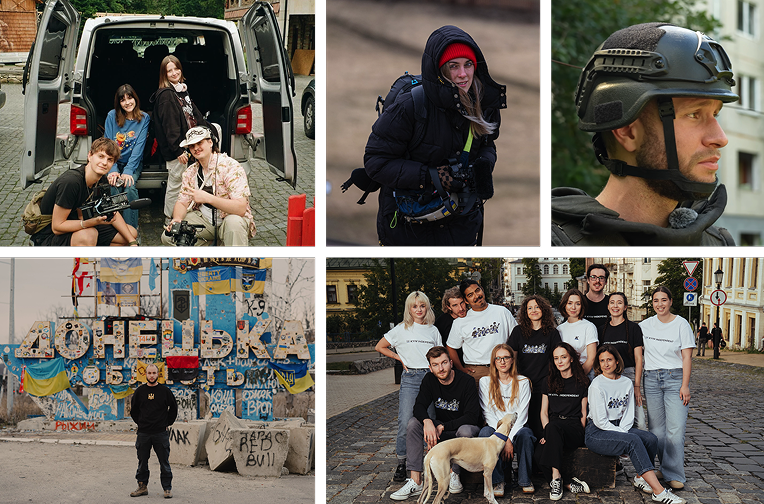
The Kyiv Independent is a prize-winning independent English language media group based in Kyiv, Ukraine. They have consistently been generous to provide Pacifica with information and interviews with reporters since the beginning of Russia’s full-scale invasion in 2022. They offer groundbreaking stories and investigations not available elsewhere. In many ways, their media group parallels the values of Pacifica Network and like Pacifica, their primary source of funding comes from their audience.
Recently, Zakhar Bajuk, Chief Operating Officer of The Kyiv Independent, spoke with Ursula Ruedenberg, Pacifica’s Affiliate Network Manager about how independent media looks in Ukraine. He talked about how independent media looks in a new democracy that is simultaneously fighting a war if the concept of independent media can withstand such pressures, or conversely, if independent media is more necessary than ever under those circumstances.
URSULA: I’d like to start our conversation with the fact that The Kiv Independent often describes its origins as “Out of a fight for free speech.” What does that mean – tell us your origin story.
ZAKHAR: I’m happy to do so, it’s something that we care deeply about. Kyiv Independent, is a Ukrainian publication based in Kyiv, and we are quite young, a bit over four years old. There was another publication like us in Ukraine called Kyiv Post, doing English language journalism with readers all over the world interested in what’s going on in Ukraine and Eastern Europe. The Kyiv Post was owned by a small oligarch for a few years, and he promised that he would not interfere in the editorial independence. For a few years that was the case, but back in November 2021 he essentially kind of got fed up with that. Most likely with pressure from different people in power, he got tired of reporting that was critical and too independent, and he fired the whole team.
URSULA: What were the grounds for firing?
ZAKHAR: Essentially, he fired them because he wanted to hire another chief editor without any consent from the editorial team and without any usual process, essentially interfering into the editorial work. He understood that the easiest solution would be to fire everyone and start building a new team, but it was November 2021 and the rumors that Russia might invade Ukraine with a full force were already very much in the air so it was really a very stupid moment to lose an English language voice out of Ukraine. That was one of the reasons why The Kyiv Independent was founded literally a week after that firing happened. When the news team was fired, they joined together and co-founded The Kyiv Independent, together with a consulting company. The idea was to no longer be owned by one person, to be owned by staff, and to independent from any outside influence of one person, yeah.
URSULA: You’re saying that the journalists who were fired would own the paper, making it a worker- owned business?
ZAKHAR: That’s right. The newsroom is the majority co-owner. That was one major big difference. Another big difference is that we pledged to fund our work ourselves – a financially independent business model allowing us to remain free from one majority advertiser or one big donor.
So, this is part of the work that I focus on the most, in my role as Chief Operating Officer. We are funded primarily by the people that read and listen and watch the material that you provide and to date, we have almost 30,000 member- supporters. Audience / member support is a very unusual funding model in Ukraine.
URSULA: In that way, you’re very much like Pacifica and community radio here in the United States. It is a funding model pioneered by Pacifica Radio.
ZAKHAR: When we started back in 2022, our main focus was breaking news and frontline journalism. Since then, a lot of things have changed, so we launched coverage of culture and history of Ukraine. We launched business coverage and coverage of other countries around Ukraine, because there is a lot of impact and influence on Ukraine, as you might see with Russia. So, we have a newsletter, for example, about Belarus. We have actually a newsletter about Russia. It’s called What the Fuck is Wrong with Russia? Ukraine actually has a history of understanding Russia. Most Ukrainians know both Ukrainian and Russian language, while Russians only know Russian language. We also launched a team that is doing investigative documentaries about Russian war crimes in Ukraine. It is very important to dedicate a separate investigative team to this; It’s a really hard job with topics ranging from torture of Ukrainian soldiers in captivity to stealing of Ukrainian art from museums. There’s so many war crimes that Russia unfortunately committed and keeps committing. We want to add a human element: to do investigations but also tell stories of the people who suffer.
URSULA: How do you think that the Kyiv independent contributes to Ukraine?
ZAKHAR: Through independent journalism, even if it’s unpleasant or critical of people inside Ukraine or of people outside Ukraine, it’s very important to stress that we are not a government publication doing PR for Ukraine. I’m not saying it’s bad; Ukraine should work on its image, but that’s not our job. You need to have journalism that is independent that serves readers. Even though we are in English, a lot of our stories, especially exclusive investigations, are noticed in Ukraine, and talked about both in government and among people. But we believe that for a functioning democracy to succeed in Ukraine, it must be connected with other countries around the world, have allies, and be part of the European Union. So we have a very specific mission to be a bridge between Ukraine and the world – specifically through journalism. That’s why we didn’t do a Ukrainian language version of our website – building those bridges and connections is such a big task. For example, we know that we are read by foreign ministries and decision-makers in governments in countries that support Ukraine. And we have readers in 100 plus countries; the United States is our biggest country – maybe around a third of our readers – and then we have the leaders in United Kingdom, Canada, Australia, and Western Europe. We have a campaign going on, right now, to reach 10,000 new members in the United States. Currently, we have 8,000 and we want to get 10,000. The campaign title is: “Looking for 10,000 Americans who care.”
URSULA: Why should people in the US care about Ukraine?
ZAKHAR: A lot of things that are now happening in Ukraine have global impact. Just one example is the future of warfare. Ukraine has developed a lot of solutions such as air defense, and Ukraine is collaborating with countries in the Middle East to help them protect them.
China closely watches how the world is adapting to one country annexing the territory of the other country and solving the territorial needs by force. Obviously, there’s a lot of impact from our war on decisions that security expanded around the world, but honestly, the question comes to something even bigger. I think Ukraine now actively physically protects a lot of values built by the United States and championed after the Second World War: centrality of democracy, the protection of sovereignty of nation states, the pledge to not solve territorial disputes by force. The United State was the architect of a lot of those principles for many different reasons, but one of them was to develop a security framework. But now in Ukraine, Russia started to challenge a lot of that.
I think those are the primary reasons, but also, on a personal note, I’ve been twice to the United States, and I was surprised there’s so many similarities between Americans and Ukrainians.
I think people in United States and people in Ukraine share the value of freedom.
And Ukrainians and Americans are very entrepreneurial. That’s’ something that I would love to highlight: Ukrainians are very entrepreneurial people, good at horizontal organization. One of the reasons we were able to repel Russian attack is by regular people joining the army, becoming volunteers, launching initiatives. Even the story of The Kyiv Independent is an example of entrepreneurship in time of war. We were a small startup, three months old when the Russian invasion started, and we were a team of a bit less than 20 people, and we understood that we have this big responsibility and challenge because there was this world attention on Ukraine, and there are so many things to cover, so many things to do, and we had to adapt a lot, and since then our team grew to almost now 100 people in those four years, and it wasn’t easy, and it’s not easy now. There are so many challenges we encounter every day. But there’s so many other stories like that in Ukraine, like soldier units being built by soldiers themselves and the building of new types of defense companies that are at the edge of innovation. A lot of this happened in very harsh conditions.
Finally, a similarity I see between people in United States and Ukraine, is in the issue of national identity. Being a Ukrainian, it’s not just the ethnicity, it’s also a matter of having an idea.
URSULA: It’s true that the essence of being an American is an idea.
ZAKHAR: Some nation states are built around ethnicity, and some are built around political ideas. Ukraine is an interesting mix of both. Because just like in the United States, there’s a lot of diversity and versatility inside Ukraine. Ukraine is the biggest country in Europe. We have mountains, we have sea, we have a small desert in the south of Ukraine – which is now half occupied.
I think diversity is a strength, but historically Russia used diversity to build division in Ukraine, and I was always surprised how more angry and sort of anxious Russians are against other nationalities – xenophobic – against other nationalities, race and even gender. But in Ukraine, people are naturally
more liberal towards that, because they are used to different languages.
You know, I was born in Western Ukraine in a Ukrainian-language environment, but I remember at 18 my girlfriend spoke Russian, while I was speaking Ukrainian, and people were used to that. And now, because Russia weaponizes the language so much by equating Russian-speaking people to Russians, so people are now often refusing to speak Russian, because they feel like Russia is using it against them. But being open to different ideas is Ukrainian tradition, similar to people in United States.
So there is a lot of similarities, and I think that’s a reason why people United States should care about what’s going on in Ukraine. We are looking for those people, because we believe that, despite everything that happens in the United States, despite all the big problems, and the administration, and the war in the Middle East, there is many people in the United States that still care about Ukraine, or maybe developed some connection to what’s going on, in the past four years.
URSULA: You are a digital platform?
ZAKHAR: We are a digital only publication, found at KyivIndependent.com and our documentaries are on YouTube. And we have newsletters. Please check it out, we really want you to be with us in our community. We have quite a few colleagues in our team who are Americans who moved to Ukraine to work at the Kyiv Independent. We have Ukrainians who now live in states and work at the Kyiv Independent. We don’t want to give up on United States. We believe what we do and represent matters to Americans who care about what’s right, about democracy and who care about journalism, which is under attack in the whole world.
URSULA: Do you have a First Amendment in Ukraine protecting freedom of the press?
ZAKHAR: I don’t think it’s as explicitly stated as in the United States, but we do have laws in Ukraine that protect journalistic work. I think our past track record of protecting free press is worse than United States – although it’s now getting worse in United States as well.
URSULA: One of the things that I’ve noticed about The Kyiv independent is that it can be extremely critical of the government; it can be very critical of President Zelensky. What is your relationship to the
government? How do you get along with them?
ZAKHAR: For a long time, I think we are a bit under the radar for them, as our influence was more outside of Ukraine. I remember there’s this story where we were not invited to off the record briefings with the President. until a foreign embassy asked the administration to start inviting us!
URSULA: That’s funny.
ZAKHAR: Since then, things have evolved and I think they started to understand our influence. There were a number of occasions when some of our investigations were not liked by people in power, and we had moments of, you know, unwanted attention from security services. So, we had some unpleasant situations, but when we went public with it, they said, ‘That’s a mistake,’ and that they support free speech.
I think our relationship overall is, you know, very pragmatic. We cover both their achievements and mistakes. There is an immense level of responsibility and pressure on the people in government. So, personally, I feel a lot of sympathy those people who are making these hard decisions right now, But I think the main principle that we use in our relationship with the government is that we are a journalistic organization that will prioritize its core values, no matter what, and we stay independent of outside influence, not being censored, and reporting on things that are of public interest.
Obviously, as a publication, we have a clear position that is: Ukraine should win in this war and Russia wrongfully invaded our country. But that doesn’t mean that all of our stories will be positive or will be only from the lens of what will people think of the government of Ukraine, right? We don’t do that. The core lens we use is whether the story we cover is of public interest. And of course, we would love it if more people in the government recognized the value of independent journalism.
URSULA: Do you think that Ukraine is serving a purpose globally in promoting democracy?
ZAKHAR: I think yes. I think Ukraine gives people an example of a version of democracy that is maybe a bit forgotten or rusted in some countries. Democracy actually has to be protected in a lot of ways. Democracy is not an end of history, as one scholar wrote. It’s a living state that needs to be supported and built and improved and whenever you lose that momentum forward, you go backward. I think Ukraine is an example of a democracy that is very young, but it’s been able to make a lot of incredible progress over the last 30 years. We were a country that had two big revolutions in the last 20 years; two mass revolutions, and they both succeeded.
Also, I need to check my history, but I think it’s the only country out of the former Soviet Union countries, apart from Baltic states, with no periods where one guy captured power for 20 years, like what happened in Russia, or in Belarus, or in Azerbaijan, or in Central Asia. Since 90s, we have had fair elections, and it was not easy. But despite the difficulties, the situation was slowly improving, and whenever it was sliding back, people did something about it. They went on the streets. Even last year in Ukraine, we had a big corruption scandal in Ukraine, when there was an attempt to undermine the independence of our anti-corruption bodies, and people went on the streets – during the war, and that law was changed. So I think you can learn from things that are happening in Ukraine and you can apply some of those experiences to your own political life in your own country both successes and mistakes.
But I think Ukraine is in the unique position of having to both develop a democracy and protect its independence from, you know, the biggest country on earth with nuclear arsenal. It’s a uniquely hard challenge, and that’s why I’m really so passionate about my job. I believe that more people should come to Ukraine, visit Ukraine, understand us better. I met so many people who either think that the war already ended and there is nothing going on, or people who think that Ukrainians are heroes, but underdeveloped and sitting in their in basements, hiding from rocket attacks.
Yes, there is a gigantic tragedy in Ukraine, and there’s so much loss of life, and a lot of people in Ukraine, including myself, have friends who were killed over these four years, but we also did so many things over these four years. We also innovated, built, developed, adapted a lot of our lives. It’s hard. It keeps on being hard, but I think there’s a lot of people can learn from Ukraine, and that’s part of our mission at The Kyiv Independent: another mission of The Kyiv Independent: building a more holistic picture of what Ukraine is.
URSULA: Well, thank you so much, Zahir. How do we end this conversation?
ZAKHAR: Thank you, it’s been a pleasure, a pleasure to be here, and hopefully readers will find this conversation valuable. I will just say that I recommend that if you found this interesting, come and give us a try at The Kyiv Independent – read one story and see whether that fits you. We want our readers to be as diverse as possible. We are looking for anyone who cares about these topics.
URSULA: Thank you, Zahar. Have a good evening.