
Host Nan Evans opens the second episode of ‘Mysteries of the Deep Ocean‘ with reminders of two key planetary facts:
Over 70% of the earth’s surface is ocean water.
Over 80% of our oceans are unexplored.
We barely know the planet we call home.
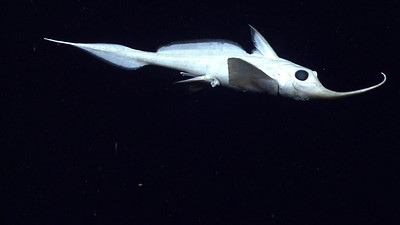
In April, May and June, KPTZ’s Nature Now guided listeners into the deep. In its three-part series ‘Mysteries of the Deep Ocean,’ Evans spoke with oceanographer Dr. Chris Kelley.
Retired now and living in KPTZ’s home community of Port Townsend, Kelley has worked on deep water fisheries, researched biological communities that live in the very deep sea, identified deep water animals in submersible operations, archived deep water dives and created online identification guides. He has completed at least 100 submersible and ROV (remotely-operated vehicles) dives into the deep ocean.
On July 23, Diane Reinhardt spoke with Nan Evans about what scientists have discovered about this unexplored world and why that knowledge matters.
This conversation has been edited for length and sequence.
Diane Reinhardt
Nan, thank you for taking the time to speak with me today and for your work and the KPTZ team’s work on Nature Now.
I’d like to start our conversation with a question you posed in the final episode. In those last minutes, you asked Dr. Kelley, ‘Why care?’
So, in light of how little the human race knows about the deep ocean: Why do you think knowledge of the deep ocean matters? Why should we care?
Nan
Why should we, as human beings, living in a terrestrial world, care to learn about and protect and conserve this very strange ecosystem? I think it’s a question to ask for any ecosystem; but, in the ocean world, it’s such an expanse of the imagination. Life on our planet began in the sea and may at some stage even return to the sea.
The deep sea is amazingly curious, strange, weird, and unknown. To think about life in the deep sea challenges our imagination and stimulates our curiosity. [I ask] how does life even happen? What are the forces down there? What is the environment? All three parts of this Nature Now series begin to explore these questions.
In the last of the series, we talked about, from a human perspective, what does the deep ocean offer to human society. Beyond the expanse of human knowledge, we are learning that the deep sea can offer benefits to human society in areas such as medicine, bio-engineering, and materials science. The deep sea has the potential for providing answers to many emerging questions for human society. One example is providing the enzymes needed to analyze and replicate complex molecules such as DNA.
And, of course, there are massive economic issues that arise when we consider use and extraction of deep sea resources. We must understand and value both the wonder of that world and the ethics of being able to appreciate and protect that world in the face of the pragmatics of the common, but self-centered ‘What’s in it for me?’ question.
Diane
Listening through the programs, I found myself thinking about how joyfully strange some of these creatures were. Then, at the beginning of the third episode, you looked back and said, ‘Well, we talked about habitat, and we talked about an ecosystem in which pressure and oxygen levels require creative adaptations;’ and, at that point it clicked for me that these creatures face the same survival issues as we wrestle with on land. We wrestle with adapting to habitat and ecosystems. And that in this deep ocean environment is this amazing variety of ways that these beings have solved those problems, the many remarkable, strange adaptations that you talked about.
Nan
I love that you picked up on that. It’s the diversity of life, the fascination of life, and the similarities of what we all face as creatures presented with these same issues.
Diane
I felt that particularly when you were pointing out that it’s hard for us to imagine a world without light, and yet these creatures adapt. Chris said that glass sponges in the Antarctic could be 15,000 years old and talked about commensal relationships [relationships that are beneficial to one, without harm to the other], and what a great social and environmental lesson that would be for humans on land.
Nan
I was thrilled he had so many examples of such relationships in a deep sea ecosystem, and I think being aware of those interrelationships brings our thinking to a higher level.
Another thing that shifted my perceptions in the conversation with Chris is that I had this bias that the deep sea was kind of extreme: it’s so cold, it’s so deep, it’s so dark, the creatures living there can be so very strange. But he talked about it as, ‘No, actually we on land are the extremists.’ We inhabit such a small proportion of habitats on the surface of our world. The deep sea is at least 70% of the planet’s area and land is much less than that. Our evolution came from creatures in the sea. Just by shifting the perspective of being so very human-centric and terrestrial-centric, I found expanded my mind a lot.
Diane
And for me that’s part of the response to that question of ‘Why care?’ Maybe that’s the big question that we ask in earthly matters…why do we care that bees survive? We care because it’s the multitude of life on the planet and we’re one among them.
Let’s shift to a more personal perspective. What specifically inspired you to create this ocean series for Nature Now?
Nan Evans
I suppose my own inspiration was that [the ocean] has always been fascinating to me because it is such a strange, interesting, curious, marvelous, surprising mystery. I’m fascinated by such things.
And then [my guest] Chris Kelly happens to live in the same town I do. He retired here after a long career, mostly living in Hawaii, working out of the deep ocean. I met him through some activities at our local Marine Science Center, and I [knew] I needed to talk to him on Nature Now because he’s so interesting. I had no idea it was going to work into a three-part series. It just evolved that way.
Diane
What is your background? Does your background connect you to the ocean?
Nan
It does in kind of strange ways. As a child, my parents would take my brother and I on these month-long camping trips to explore the US. We grew up in the flat part of Ohio. I was always enchanted by oceans and mountains, so that was the initial trigger. I knew as an adult I needed to live where there were oceans and mountains.
Also, I pursued biology in college and grad school and then found my way into oceanography as a postgraduate area of interest. My career morphed a lot.
[Over time,] I realized that my interests and my talents were more suited to helping other people grasp things that fascinated me; and, frankly, the notion of being a research scientist became much less interesting to me personally.
I left science and entered the world of policy, of government program management, all around natural resources. I worked with both the Federal government and the state of Oregon; and, in the last part of my career, I did government relations for the Nature Conservancy.
Diane
And eventually you connected with KPTZ. Let’s talk about Nature Now as a whole: the background of the show, how these programs fit into the program’s larger design, and your history with KPTZ and the program.
Nan
Nature Now first aired on KPTZ in May 2011. It was one of the very first programs the station had.
KPTZ is a community station, so people in the community were throwing around ideas as the plan for a new radio station developed. The idea [for the show] came from someone who is not a naturalist, per se. She had enjoyed Bird Note Daily [a two-minute radio show that tells stories of the lives of birds] and thought it would be great to have a program on our radio station that talked about the natural world around us. Initially, [the program] was mostly about increasing the awareness and the knowledge of the local environment in a way that was not only informative and insightful but that could also be engaging and fun and interesting.
We’ve matured over our 15 years to really want to encourage curiosity, to make asking questions something that our minds just do, to promote understanding about the natural world of which humans are part, and to appreciate the interconnectedness of how we fit into the natural world biome, into ecosystems.
Then, as we matured even further, we [became] less constrained by the notion of being regional or local and expanded to shows that are inspired by the beauty of the natural world, the depth of the natural world, the universal. We added artists as occasional guests on the show. We added authors. I had my first interview with a philosopher that ended up being three or four separate programs. We want to raise questions of ethics, of responsibilities, of action. So there’ll be programs on native bees, and then there’ll be a program [that asks], ‘What is our responsibility as human beings?’ or [an interview with] a person who has dedicated their life to making beautiful photographs.
I think we’re targeted to everyone, not children, not adults, everyone, not scientists, not humanists, just everyone. We make it fun and joyful and informative to trigger critical thinkers while keeping a conversation.
Diane
And what has been your connection with KPTZ? with Nature Now?
Nan
When I retired, I moved up to Port Townsend from Portland, Oregon and opened myself to whatever would come my way.
I was meeting people in the natural history world, the biology world, the ecology world; and, through word of mouth, there was an opportunity to join this radio program. [The show] was maybe two or three years old at the time. The person who had started it was thinking about expanding the number of people involved, and I said, ‘Well, I’ll give it a try. Why not?’ And it grew from there.
When the founder of the show retired, I took over the production. I’ve been the main producer and host now for over 10 years.
What keeps me engaged is [the program’s] evolution, the constant learning, the constant expanding of my own horizons, thinking about questions to ask somebody. [I ask] ‘What would a listening member of our audience want to know?’ and ‘How does it relate to the world we do know?’ It’s my own passion for the natural world too. That drives me.
[It’s important to] me that the program be conversational, to ask the questions that come to a curious mind, and to know enough about how biological systems work to be able to think about what those questions would be.
Diane
There are other hosts who work with you.
Nan
We have a team. There are three hosts, one from the first days, me from the early days, and a third person from the fairly recent days. We’re all driven by knowledge and passion.
We have a person who does the sound engineering and editing, and another younger woman who said to me, over coffee, you need podcasts. I said, ‘We have podcasts on the radio station.’ She said, ‘No, that’s not the way people get information these days.’ So it’s a real education for me to find she’s absolutely right. Now, she manages our podcast app. We’re on Apple and Spotify and Instagram. She’s taken us beyond the constraints of a community radio station into these other ways people learn and are exposed to things. And we’re really interested in franchising Nature Now because we love the show, so we’re thinking we can just give this program out to other stations who might be interested.
Diane
KPTZ is located in Port Townsend, a harbor town perched at the tip of northern Washington’s Olympic Peninsula, jutting into an inlet off the Pacific. So, I’m wondering how much does your community’s geographic location and environment impact the programming choices you make?
Nan
When people have asked me similar questions, I’ve always said we are now defining the notion of ‘regional’ with very fluid boundaries. We all on this globe are interconnected, and so the deep sea may not have a direct impact on our local communities, but certainly there are interconnected ties there.
Port Townsend is a very water-oriented community. The public school system, when it was struggling, 10 or 12 years ago, decided to structure a lot of the education around the theme of the maritime world, from the trades to the sciences to the arts, so that’s a thread that goes through the whole educational system. It’s amazing how creative the educators can be in making ties relevant to kids.
So, definitely location does have an impact. Is it a direct line? Probably not. It’s serendipity, who’s available to talk to. Chris Kelly happened to retire to this town. It’s knowing the richness of your own community, and we have a very rich community of people with lots of engagement and commitment to community issues of all kinds. It’s an expression of the respect and interest in our community, appreciating the diversity of it, that extraordinariness of looking at a community, at who’s living there, what their backgrounds are, what their interests are.
Diane
So, my last question comes from a sadder sense of serendipity. Shortly after I saw that your deep ocean series was running, on May 21, President Trump announced that he was dismantling the Ocean Observatories Initiative [a network of over 900 instruments that monitor ocean health and marine biodiversity operational since 2016]. Remarkably, on June 16, the Senate passed a bill pausing that destruction; and, on June 17, President Trump announced that the dismantling would stop.
What would loss of that initiative have meant for your local area, for your areas of concern?
Nan
What it means has been reflected in the fact that there was bipartisan opposition to its being destroyed because it’s not only really good hardcore science, but that system was providing some of the best science in the world. It had stations all up and down both coasts and great geographic reach. And it is important to know that, before the President’s order was stopped, ocean monitoring equipment and stations were actually removed. We have lost a number of stations off the Oregon and Washington coast.
In fact, apparently, some of the European countries, when they saw what was happening in the US, decided to pump up their ocean research because they knew how important it was. It was important for everything from global climate change to resource
use and extraction, to weather forecasting.Port Townsend community is a fishing, boat-building and repair community, and it’s a seagoing community. Knowing the weather forecasts is really important for safety. Anecdotally, I [often] go to the basic weather app on my telephone or iPad, just a sort of standard weather app; and usually I see the weather systems moving across the whole Pacific. The map shows you what the various observing stations have predicted. But I noticed, during the period of time when they were starting to pull the observing stations, that area of the ocean offshore our coast was black. That to me was a very tangible example.
If you can’t see what storms are coming in or what the weather conditions are going to be, or if we’re having an El Nino, that’s weather going to affect everyone. It affects life. It affects decision-making for people in business. The impact of removing the system extends beyond the loss of good science. It has tangible impact for communities, and those two things just made me livid when I read about it and livid that the National Science Foundation was pulling scientific monitoring stations out of the water.
And now, even though the Administration has backed off on its policy, it’s going to take years to reestablish those stations, just consider the logistics and the scheduling, the costs, and getting ship time for researchers. Planning to replace the lost stations will take multiple years, for example, just to get time on shipboard. I think we will suffer in many ways for that brief period of time where they were pulling stations.
Diane
I read that there was concern about data being lost due to the interruption.
Nan
Yes. I think that is probably true. I also think the proposed removal of the ocean data stations is reflective of the larger political situation we’re in right now. There seems to be organized and intentional efforts to destroy the credibility of science and to create a world that is not fact-based but is ideology-based, which is a big overarching concern of mine.
Diane
For me, it also circles back to what you talked about, remembering some basic facts about our planet, those percentages you cited before. If the ocean is 70% of the planet and 80% unexplored, how can we ignore that?
Nan
Obviously to our peril.
The last couple of years have been really hard, politically, and very depressing for some of us. Yet, on the other hand, they’ve helped me define and confirm my commitment to what we’re trying to do on Nature Now. We all, as individuals with a couple of friends, can make a difference.
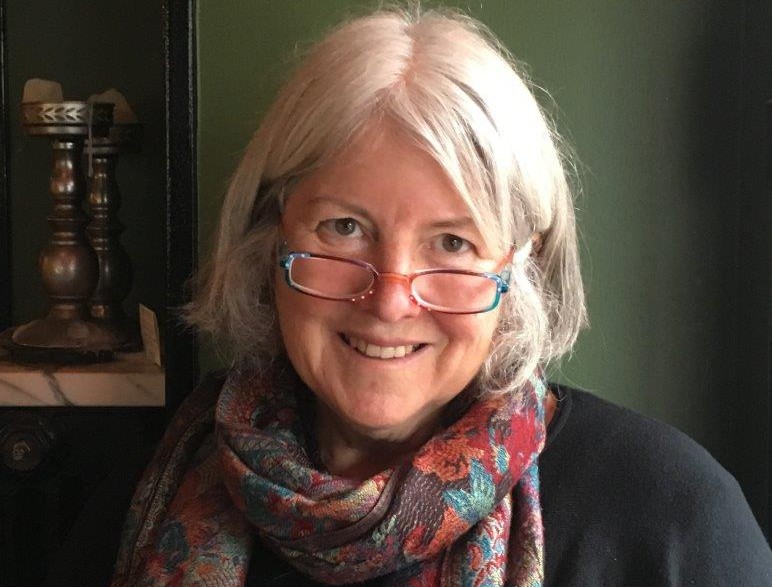
Photo of Nan Evans used with permission of Nan Evans. Photo credit KPTZ radio.