
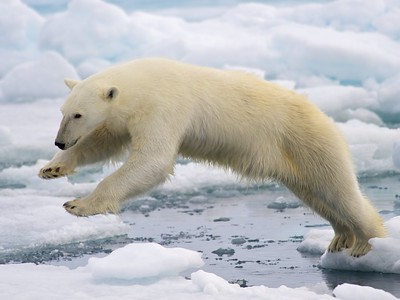
Andrew Derocher, a zoologist at the University of Alberta in Canada, has been studying polar bears since 1984 and is the leader of a decades-long study on polar bears living in the high Canadian North.
On August 5, he spoke with Big Picture Science contributor Roland Pease about his most recent field studies and his discovery that Arctic bears are struggling to find enough food.
This interview has been edited.
Roland Pease
Andrew, [during field studies,] you actually spend a few weeks in the [Arctic] area. When you get out there, what do you do?
Andrew Derocher
For the work that I’m interested in, it’s much better to be out in the springtime because its really the time of year when polar bears make their living. This is when they’re hunting, killing seals, putting on weight. It’s also the mating season. So we get a lot more insights into their life history at this time of year.
We’re out there for about a month. We wake up in the morning, and, typical of the Arctic, you’re usually waiting for weather. We can only work on sunny days that aren’t too windy because we need to track bears. That’s how we find them. They’re at very low densities. So, if you just fly around, you’ll never find them or very rarely. We have to get on their tracks.
We find the bear. We assess their size, and then we use an immobilizing agent. We fire it from a dart gun, and the bears are asleep, usually within about five minutes. Then they’re safe to approach and work on. They’re asleep for about an hour. They’re safe to be with. Then we get out of their hair and leave them alone to do what they were doing.
Pease
But for that one hour, that’s pretty intense work, isn’t it?
Derocher
It is. Yes, it is. There is a whole bunch of different things that we’re doing. A lot of the work that we’re looking at right now is focused on satellite telemetry. In the springtime, we’re deploying ear tag radios. These are small transmitters, about half the size of a little matchbox. We put it on the ear, and then we can follow these bears. We’re looking for their movements, their habitat use, how they’re responding to changing sea ice conditions, and, in particular, when are they giving up on the sea ice and being forced ashore.
When we’re doing work on polar bears, it’s never the bear that’s drugged that I’m worried about. It’s the bears in the area that I didn’t see. You know, your head’s down, looking at the bear, monitoring them, how they’re doing, and then all of a sudden you turn around and there’s another very curious bear watching you. It’s a little unnerving.
Pease
So, when you were doing your work, are you saying that the whole of the Hudson Bay was full of ice, or was it just the coastal parts?
Derocher
In the springtime, the Hudson Bay is pretty much 100% ice cover. There are, of course, open areas. It’s a very dynamic habitat in this part of the Arctic. The ice is moving on wind and currents, and what we’re looking for are usually fairly stable pieces of ice that are thick enough that we can land a helicopter on. Of course, that’s typically where the bears are found because what they’re looking for are seals, and the seals are looking for stable ice as well.
Pease
So what I’ve read is that, as the ice breaks up in the Hudson, the bears have to retreat to land. Is that right?
Derocher
Yes. This is what we call a seasonal ice ecosystem where the ice disappears completely. It will be pretty much gone in next couple of weeks, and then it won’t start to reform until sometime in November and December.
And that’s really one of the critical parameters that we also try to monitor. When do the bears come on shore and when do they leave? Because, for that whole time that the bears are on land, they’re not feeding or very little. They lose about one kilogram of body mass per day. So this is one of the critical parameters: how long can they stay on land before they start to suffer the ill effects of not having enough energy stored?
Polar bears are very well adapted to going very long periods of time. They can go months and months without eating anything. That’s not a problem for the bears. We’ve got pregnant females that will go eight months without eating anything. Those bears come ashore absolutely obese, and they’re adapted to fatten and go for these long periods.
But other bears are really not able to go for maybe 200 days. So those are the bears that switch from a controlled fasting to basically starvation. And, of course, at the end of starvation is death. You know, we think about polar bears being a carnivore, but I’ve called them a ‘lipovore.’ They eat lipids or fat, and that’s what makes a polar bear tick. They just sort of walk around the Arctic, kill a seal, and then suck the blubber off those seals. It goes almost unchanged from the seal right into their own fat stores.
Pease
What do the polar bears do once they’re on land? Are they hanging around, getting bored, or are they trying to scrape some kind of a living off the things that they can find?
Derocher
Well, there’s a lot of variation. You have to remember that polar bears really are individuals. They’ve got their own behaviors, their own patterns, and so it varies.
Some of the big male polar bears hit the beach in Hudson Bay. They just sit there for the whole summer. They’ll make a nice little shallow area. They actually become quite social. You can have the equivalent of 1,520 polar bears in an area the size of your house. They’ll lie right next to each other, incredibly social. Every so often, if it’s a nice cool day, they’ll do some play wrestling and things like that. But they’re just in an energy-conservation mode.
Other bears, pregnant females, go far inland. They’ll try to get away from other bears and try to find a place to start digging a den. Mothers with cubs are sort of spread on the inside areas as well, away from the coast. They don’t want to be bothered by other bears. Sometimes they’ll eat berries. Sometimes they’ll be lucky and find a dead seal. But there’s really precious little for the bears to eat when they’re on land in summer.
Pease
You just mentioned cubs, and I hadn’t thought about that. Are they affected by this changing ice cover? How do they feed? Are they entirely fed by their mothers?
Derocher
Polar bear cubs will stay with their mother for two and a half years. It’s kind of typical of most species. It’s the really young and the really old that are vulnerable to these changes.
The biggest problem for the really young ones is, if mum doesn’t get enough fat stored, she will stop nursing. And, once she stops nursing, then the cubs are on their own for food. Of course, during the summer time, there’s not much there, and so this is a real weak point in their life history. We suspect that that’s probably where a lot of these populations are getting in trouble. Mum stops lactating because, of course, she needs to survive to reproduce again. A female polar bear can keep reproducing well into her 20s, so the cubs sort of become disposable at that point. We do see years when the bears are in such poor condition that we see much higher cub mortality.
Pease
I was wondering if cubs or the mothers themselves, or some [specific populations] of polar bears are more vulnerable to these changes than the big males?
Derocher
Exactly. Yeah. There’s a lot of variation in terms of the dynamics of the sea ice, what prey are available to the bears, and the seasonality differs a lot as well.
Pease
But also, presumably, the impacts of global warming is differing.
Derocher
Exactly. We’ve got populations in decline. The Western Hudson Bay population has declined about half over the years that I’ve been studying there, since the 1980’s. Other areas are pretty robust and doing quite well.
It all comes back to how much the sea ice has changed and what is the structure of that ecosystem. In some areas, we’re seeing sea ice loss, but the bears are responding well to it. It depends on where the seals are, and are the seals being affected, and can the bears still get them. So, some areas that are losing sea ice very quickly are still doing okay from the polar bear’s perspective. But it’s probably a limited time offer sort of thing. These ecosystems will be impacted eventually.
Pease
So, even if there’s a short term gain, that’s not the long term prospect.
Derocher
That’s exactly it. And you know we’re not talking about the extinction of polar bears any time in the foreseeable future. What we’re talking about is sort of the erosion of the species at the edges, and those ecosystems that are being most affected could blink out, and we’re talking within the coming decades. But it’s very hard to predict because we’re really dependent on what the sea ice is doing and what the sea ice scientists tell us are the likely outcomes of warming.
Pease
You said that you’ve been involved in studying these bears for four decades or more. This particular project in the West Hudson Bay goes back to the 70’s or even the 60’s. In all those years, have you learned what you wanted to know about their biology and about their life cycle and their life histories?
Derocher
I could do this for another 50 years, if I had the chance. There’s no question that we are seeing changes in the population. But I didn’t get into this to study the effects of humans on polar bears. I was really interested in their natural history, and it’s kind of unfortunate that a lot of my career has been spent studying the unnatural history of polar bears. When I worked in the Norwegian Arctic, I was studying the effects of pollution; and, since that time, I’ve really been focused on the effects of climate change on the bears.
Pease
I saw that you first noted that there’s probably a connection between climate change and their body mass back in the 90’s.
Derocher
Yes. There were early warnings. We at that time didn’t really know what was going on. It wasn’t until we sat down, myself and a colleague, Ian Sterling, and wrote a paper in 1993 about the potential effects of climate change on polar bears. But, at that time, both of us thought that this was something far, far away in the future. I did not foresee that it would be so manifest over my career.
Pease
When you’re going back year after year, I guess sometimes you come across the same bears again and again.Are there any that you recognize from their behavior? You mentioned them being a bit individual.
Derocher
It’s clear. There’s different levels of aggression. For example, some bears, when you come in with the helicopter, they’re quite confused. Other bears are just quite angry. They’ll come rushing at the helicopter. We see that sort of behavior repeatedly, and it’s fascinating.
I’ve caught some of these big males, and they come to exactly the same spot year after year after year.
This is an animal that’s moving over hundreds and hundreds of kilometers in this featureless environment, migrating out across the bay, and yet they’ll come back to sit on the same little point of land every year in a row. There’s this fidelity. Bears are real home bodies. They like to come back to the same place, but some of them have this affinity to a location that’s just astounding.
Pease
You were talking a bit about the future of ice. I’ll bring it back to the Hudson Bay. We know that the ice is getting thinner and melting more year on year as a trend. Are the climate forecasters able to tell you what the ice will look like in Hudson Bay in 2030? Let’s say we were able to keep to the Paris target of two degrees of warming, or something like that, which is quite a lot of warming, probably particularly in the Arctic. What does the Hudson Bay ice look then?
Derocher
Pretty much all the climate modeling that’s been done by sea ice scientists is not good for polar bears in the Hudson Bay ecosystem. Most projections say that the bears probably won’t persist beyond mid-century in that area. There’s just not going to be enough ice.
People always ask how can you predict that. Well, it’s interesting because climate change has happened in the past, but for natural reasons. If you go back in the history of polar bears, we know that they were down around Denmark and southern Sweden during the last Ice Age. But, as the climate warmed, the bears slowly moved further and further north. The problem with directional warming, like we have now, is that eventually the areas that they’re currently living in just won’t have enough sea ice. That’s the situation down in the Baltic Sea. It still freezes in winter. The bears used to be there, but they’re not there anymore. So there’s certain limitations to how far you can push any species; and polar bears, in some parts of their range, are getting pretty close to that edge.
Pease
And the fact that you’re still doing what has come to be quite a long career studying this. You obviously find the allure irresistible.
Derocher
The sea ice environment is where I’m probably the happiest. It’s just an incredibly beautiful, serene part of the world. It’s where polar bears make their living, and tracking a polar bear, seeing what they’re killing, where they’re killing seals, and what they’re eating from them, the mating behavior…40 years on, I could keep going. Polar bears are an endlessly fascinating species, and I feel fortunate every time I’m out on the ice to work with them.
Pease
Andrew Derocher, thank you so much for talking to Big Picture Science.
Derocher
It’s been my pleasure. Thank you.