
In December, 2025, some 3,000 federal agents from US Immigration and Customs Enforcement (ICE), Customs and Border Patrol (CBP), and Homeland Security (DHS) arrived in the Minnesota Twin Cities of Minneapolis and St. Paul. Over the next 4 months–and continuing, in decreased numbers, still today–officers from these agencies apprehended and arrested immigrant residents, with a particular Trump-driven focus on the local Somali community.
Through it all, St. Paul’s WFNU-LP continued to broadcast. The station, founded in 2011, is “The Voice of Frogtown,” St. Paul’s most racially-diverse neighborhood.
In May, Diane Reinhardt spoke with Philip Gracia, station President and CEO, about the station’s founding and future and about the impact on and the response of the community to the federal government’s operations.
This interview has been edited for length and sequence.
Diane
First, Philip, let me welcome WFNU-LP to the Pacifica Affiliate Network and thank you for taking the time to speak with me today.
Minnesota and specifically communities in the Twin Cities have been under a particular strain these past six months. I’d like to start with that crisis. What has the deployment of federal agents meant for the Frogtown community and the station?
Philip
This is a sad, sad story. When ICE decided they wanted to come to the Twin Cities, they shut [the cities] down. People weren’t leaving their houses. They weren’t going to work. They weren’t going out to eat. Kids were scared to go to school. They were scared to leave their parents. There’s so much that could be said; but the one thing [is that] people were scared.
Diane
On the WFNU-LP website, you prominently feature a link for immigrant resources and a description of your support for the Neighborhood House [a nonprofit that provides free services to immigrants, refugees, and low-income families].
Philip
We’re very proud of the alliance that we have with the Neighborhood House. They helped so many immigrants and people get through the surge. We gathered supplies ourselves. We weren’t the only ones, but we were taking in clothing, food, everything you can imagine, seven truckloads over the period of time ICE was in town that we took to the Neighborhood House.
[We worked closely with] one community member, Yellow Bird Coffee Bar, in St Paul. I just picked up a package today to take over there on my way home. [Our] donations are collected [at Yellow Bird]. We’re not always at the station; so, we found a landing place for them.
Diane
Did the station stay on the air throughout the peak of the deployment?
Philip
Yes, we did. We were on the air. We had enough people. Still, to this day, there are people who aren’t doing their shows. They’re doing them from home or they’re not doing them at all and are running repeats of past shows because they don’t feel comfortable in this climate. ICE is still here, just not in the numbers like they were.
Diane
And were you able to simultaneously report on what was going on?
Philip
People talked about it on their shows, but we did not have any direct programming about the situation. We didn’t want to make ourselves a target. Basically, we were looking out for the safety of our guests and hosts.
Diane
I can only imagine how frightening it must have been.
Philip
For everyone. Our location is in a Radisson Hotel downtown. Other hotels in St. Paul closed their doors during the surge. But the Radisson Hotel stayed open and was a safe place. They didn’t let ICE come in.
And, on No Kings Day, our hotel was packed with people who were giving their piece of mind to the person who is a so-called King.
Diane
And what has been the aftermath?
Philip
They’re still here. At its height, there were about 3500 here. There’s still about 650 to 700 here.
Diane
Still a lot of reason for fear.
Philip
Yes, absolutely. There are still kids not going to school. There are people still hunkering down.
Diane
The station website identifies Frogtown as the most racially diverse neighborhood in St Paul.
Can you tell me more about the St. Paul and Frogtown community?
Philip
The St. Paul community is a pretty diverse community. The last census [reported that] there were more minorities in St. Paul than there were Caucasians, [a larger total number of people who identify as] black, African American, Asian Pacific Islander, American Indian and Hispanic. And we also have African refugees from Somalia, the second largest Somalian community in the United States,
Diane
And WFNU-LP’s tagline defines the station as “the voice of Frogtown.” So can you tell me about your local programming and how that programming connects to a diverse community.
Philip
There are a couple of music shows that are based upon people’s heritage. We have a show called The Brazil Show [hosted by] DJ Izzie who was born and raised in Brazil. She plays Brazilian music and that helps soothe a lot of people. Also, we have a show called Periphery Radio that plays music from all over the world. Both of those shows are very well-received because they soothe people who are immigrants from different nationalities who are in the Twin Cities.
Diane
I saw on your schedule that you also offer a lot of local music programming.
Philip
Yes, we have musicians galore and artists; so, when we’re not doing a show that specifically plays mainstream music, we play local talent, Minnesota-born, Minnesota-bred, Minnesota music. When our schedule says “local variety,” those are all artists that have turned in music to the station that they wanted played.
We have spoken word artists, artists of different mediums, that are regulars doing shows. So, a musician from a band might come in and play the bands that they’re involved with or they support.
Diane
That’s an important service to a community’s life.
Philip
We are a community hub. [We have] a lot of elders in our neighborhood, so we have some shows for [them]. [We have] pastors, small business owners, young leaders. We’ve got a program called Listen Up Youth Radio. They are 14- to 21-year olds who do hour-long shows on a rotating basis each month.
We pride ourselves on amplifying the voices of the Frogtown and Rondo neighborhood. We train people on how to do a radio show at no cost to them, no cost to come in and ask for a show.
Diane
The website mentions that you offer both free radio broadcast training and on air practice. How does that work?
Philip
Our motto is show, tell, do. I just had an older gentleman come in to start a show on Wednesday. You train the person, first, by them looking at you do it. Next, you tell them how to do it; and then, finally, they show you how to do it.
Diane
And what is his program about?
Philip
He’s talking about community, about senior citizens, dating, food, things associated with getting out and dealing with the public at an age where somebody might need to hold the door for you or you still have the strength to hold a door for somebody else.
Diane
And the station also supports local podcasters.
Philip
We do about five or six podcasts a month. There’s only a wall between our live on-air studio and the studio for podcasting. So, if we’re not doing a live show, then we offer the podcast studio to podcast and content creators.
Diane
Are they people who have programs on the station or are podcasters a whole different group? Can they just come to the station and present their ideas?
Philip
Yes, they can. We do charge for rental. We supply all the equipment, the microphones, the cameras, the decor–we help them set up their decor if they need it; and we basically do the podcast for them. Some people take the raw file and then edit themselves, or we do the editing.
If they want to put it on our website, we do offer that. But, if they don’t, they’re putting it up on YouTube for video podcast or using all the other platforms for audio.
Diane
How many volunteers do you have?
Philip
81 as of yesterday. And we have about 50, 55 shows that are manned by these volunteers.
Diane
That’s a solid support group.
Let’s talk about the history of the station.
Philip
We thank President Obama, first off, for putting the Low-Power Community Radio Act together, signing it into law [in 2011].
The Frogtown Neighborhood Association, a non-profit, founded the station in 2015; but they couldn’t manage [both] the radio station and the non-profit at the same time. So, in 2019, three station supporters– Katey DeCelle [currently WFNU-LP Executive Director], Charles Moss Jr. [long-time WFNU-LP host] and I founded Frogtown Tuned-In as a separate non-profit and took over all of the work that the Neighborhood Association had done from 2015 through 2019. [Frogtown Tuned-In] took the torch and ran with it.
I just happened to be the lucky one who was the first host of the station and that’s when I got my drive to want to continue this. April 22, 2015 was our first broadcast played online. We used CASTER [a platform that provides tools for creating and managing internet radio stations]. You had to be listening online to hear it.
And then we put something on SoundCloud, and it was a hit. That made us know that we were someplace where people were bound to listen to us.
In 2016, we got our FM antenna, and we got plenty of press for that. Then in 2017, we moved into a church basement. We were there until 2020.
We’ve been in the Radisson since 2022. In that time, we’ve tried our best to amplify the voices of underserved individuals and to change the narrative where mainstream media has taken a hold of our narrative. If something [negative] happens in Frogtown, that’s the first thing mainstream media run. They think of [the neighborhood] as negative, you know? We’re trying to get that narrative back.
Diane
I recently saw a station Facebook post dated April 22, 2026, marking the 11th-year Anniversary of the first airing of a program called Real Talk with Real Brothers.
Philip
That was me! That was our first project!
Right now, I’m in my car parked across the street from the barbershop where Real Talk with Real Brothers was formed. I went to get my haircut one day, and this gentleman named Alvin Clardy comes in and says, ‘Hey, I’ve been looking for you.’ I said, ‘What for? I owe you money, do I?’ And he said, ‘No. I want to do a radio show with you on this new station that is popping up in Frogtown. And I said, ‘A show about what?’ He said, ‘What we do here at the barbershop, talk about everything. We can talk about gas, the price of gas, and groceries, the price of groceries, different sports. We can talk about all that stuff.’
So we did. That was how Real Talk with Real Brothers was born.
Unfortunately, we [soon] went our separate ways. I left after about six episodes. He continued for probably another six or seven episodes and then decided he was going to hang it up. I started my music show The Midday Escape in June of 2015, and that’s the longest running show on the station.
Diane
So, Real Talk with Real Brothers was the station’s first broadcast and your first connection to the station and you’ve been there ever since!
Philip
Yes! I also did a show called Funk 2 Ur Ears with my Executive Director Katey DeCelle until about two years ago. I’ve always held a position since 2019. I’ve been Station Manager, Co-Station Manager. The title has changed many times, but right now it’s President, CEO.
Diane
Did you always have an interest in radio?
Philip
When I was nine years old, my mother gave me an old Emerson radio. I listened to that radio constantly, especially sports. I wanted to be a play-by-play guy. I would practice at neighborhood baseball stadiums. I would do games at high school stadiums or high school basketball games. Then, 40 years later, I ended up getting into radio. I didn’t go to school. I just picked it all up. It’s all self-taught.
Diane
You’ve only recently affiliated with Pacifica. So, I wonder about why you made that choice and what plans you have for station.
Philip
We’ve been running Democracy Now for about two years. Now, I’m dabbling with building a workflow to be able to broadcast the American Democracy Minute Radio News Report and a couple of other shows to be determined. We’ve only been with Pacifica for three weeks. So the future is very bright on what shows we’re going to put on the station.
Diane
So, what is coming up for the station?
Philip
We want to [use our resources] to create music, video, talk, news, to create content for people. There are independent journalists who would benefit from this. There are musicians who can benefit from this. There are mom and pop businesses that can benefit, and content creators, millennials, Gen Xers, Gen Yers, whoever they are. Everybody wants to be behind a camera and on a microphone, so we’re going to make a place where they can get that done. We posted some grants. We are looking to do some expansion, but we can’t do it without the help of grant money.
Diane
And, before we close, I have to ask: where did the name Frogtown come from?
Philip
This story is not mine, but this is what I’ve heard. Back in the late 1800s, the French moved in to settle this area because of the railroads. It was a swampy area, so there were a lot of frogs. There was a swamp. And it stuck.
And, to this day, some people think of [that name] as a derogatory statement–‘Oh, you live in Frogtown.’ But it’s not. It’s a positive, positive situation.
The community is vibrant. It’s colorful. There’s more green space in Frogtown, urban green space, than any place else in the Twin Cities. There’s more diversity in Frogtown than any place else in the Twin Cities. There are nice people, very nice people. We’re just trying to take that narrative back.
We don’t want to hear [the negative.] We want to hear, ‘Oh, Frogtown is a great place, a great place to start a family, to start a business.’ We want people to have that narrative and take it away from mainstream media. As far as the station is concerned, I love it.
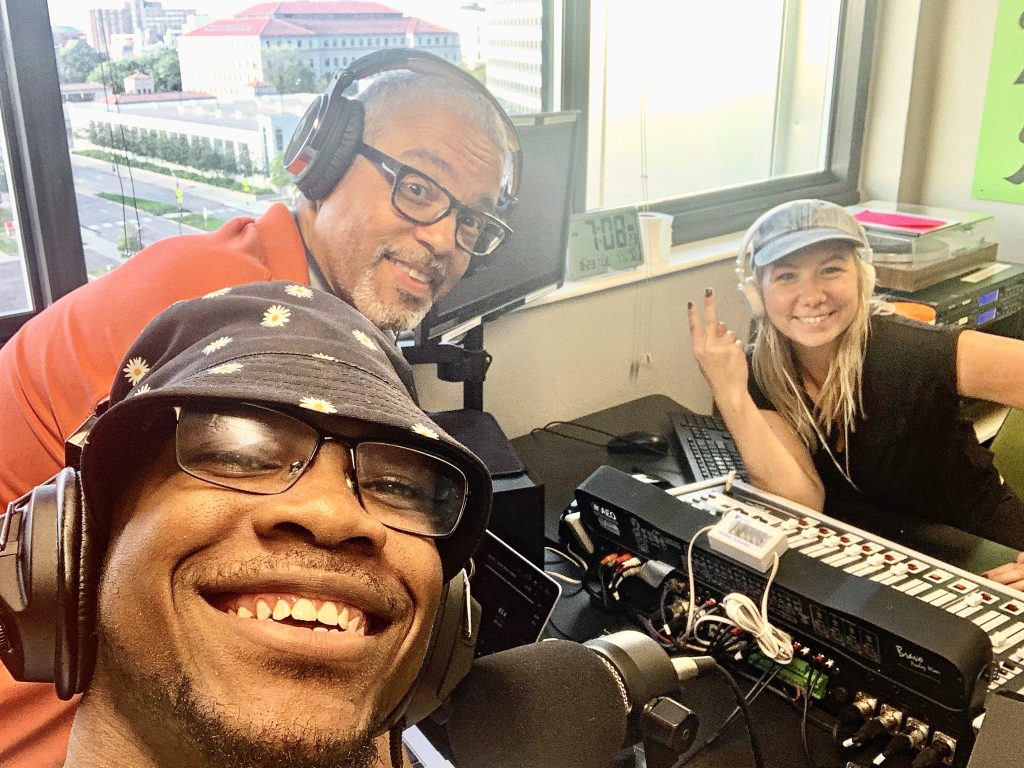
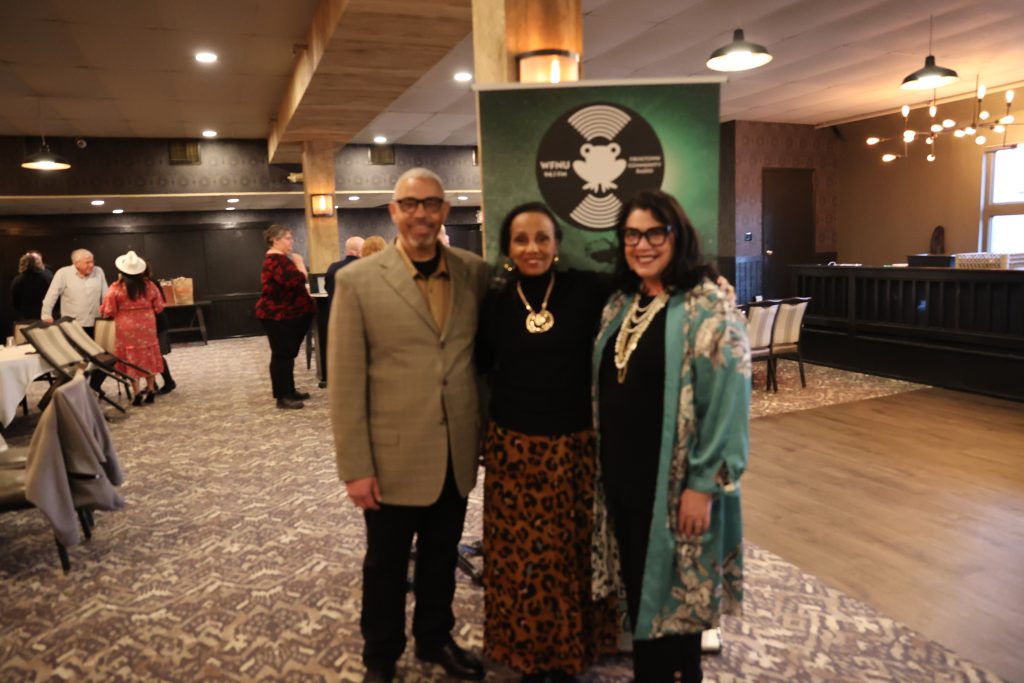
Top Photo: President Philip Gracia and Executive Director Katey DeCelle training in new host Khadar Greer. Photo used with permission from Philip Gracia. All photos used with his permission.