
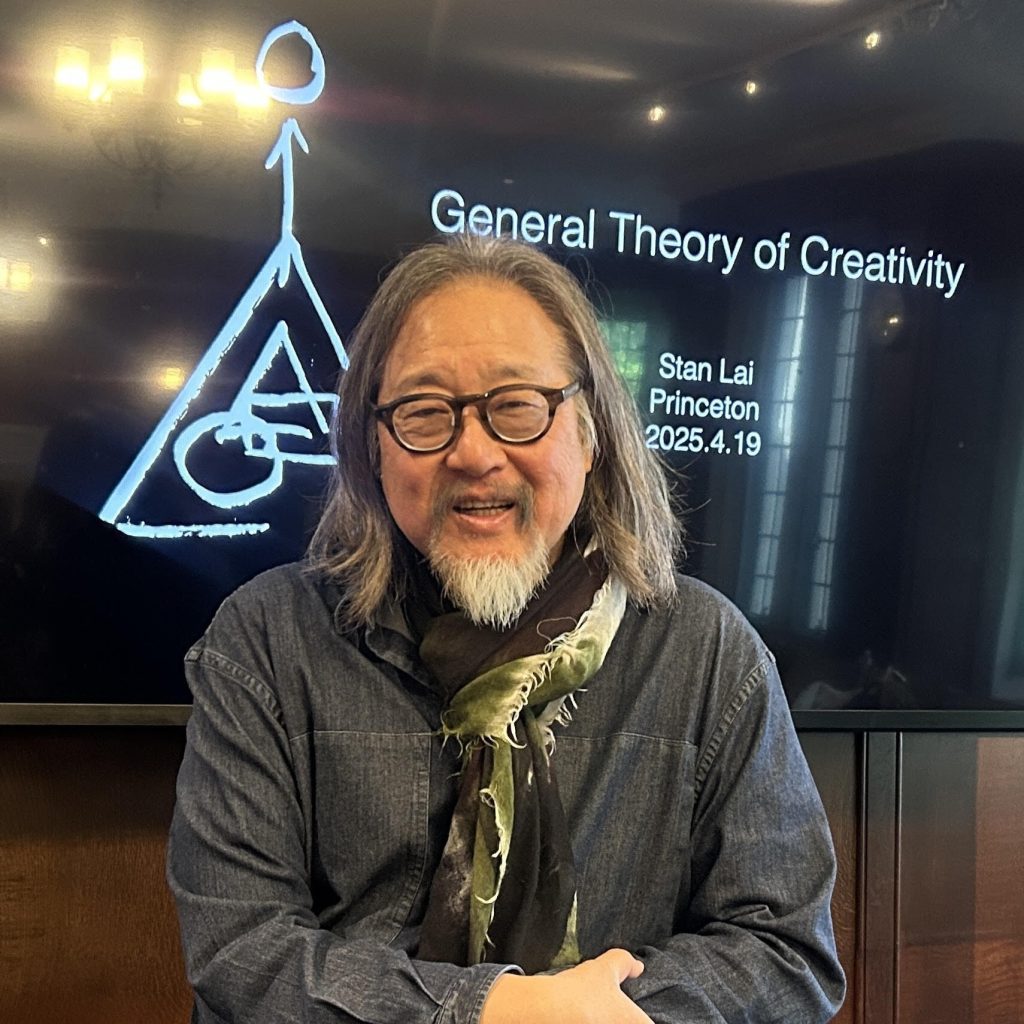
In November, 2025, Lynn Borton interviewed Stan Lai about the interplay of creativity and curiosity. She has since shared her interview with Sprouts.
‘CreativitRy,’ writes legendary playwright Stan Lai in his new book of that name, ‘doesn’t exist as a word, just as all creative things do not exist until they do, rhymes with artistry and chemistry and sorcery, [and defines] the know-how practice and mastery of creativity….We must unlearn many things
and relearn how to see and think about how we experience life and the world.’
The book, says Lynn Borton, host of podcast Choose to be Curious, ‘is Stan Lai’s English-language refinement and re-envisioning of his 2016 classic on creativity, published in Taipei and Beijing, which has sold over a million copies in Chinese. He believes we’re all born creative, but our access to that
birthright is blocked by life itself. Each chapter of the book offers opportunities for reflection. Everything, he reminds us, is our teacher.’
Born in the US and raised in Taiwan, Stan Lai is currently Artistic Director of Performance Workshop in Taiwan and Theater Above in Shanghai, as well as Co-founder and Festival Director of the Wuzhen Theater Festival and Artistic Founder of Huichang Theater Village in China.
In November, 2025, Lynn Borton interviewed Stan Lai about the interplay of creativity and curiosity. She has since shared her interview with Sprouts.
This interview has been lightly edited.
Lynn
Stan, congratulations on the release of the new book.
The overlap, undercurrent, interplay of creativity and curiosity come up a lot here at Choose to be Curious. I love that you invented your own word for this process, and I’m wondering what inspired that.
Stan
Simply, the original Chinese name did not exist either. It’s a word that means sort of like creative-ology or something like it, meaning the study of creativity. So I gave it creativitRy. I wanted to do something a
little sort of oddball.
Lynn
So I loved, when we connected about having this conversation, that you were, as you put it, immediately seeing the strong connections between curiosity and creativity; and I’m wondering in those moments what was coming up for you?
Stan
Well, throughout the writing of the book, throughout all my years of teaching and making new works for the theater, I realized how you really have to be curious about life more than anything, about living,
about people, about stories. And curiosity brings you to a study of behavior, of everything that happens in life.
And then, you look at all the great creations by mankind, over the history of humankind. Look at Einstein. If he hadn’t been curious about the universe or been obsessed about finding some sort of a formula to express the universe, we wouldn’t have all the work that he did. We wouldn’t have everything that came from that it. Curiosity is really the engine for everything. Curiosity for creative people is part of that engine that gets us going.
Lynn
So you talk about creativity as this interweaving, this navigation, this cultivation on the two sides of wisdom and method, life and art. And, thinking about curiosity in that context, I’m wondering whether
curiosity shows up differently in those two realms or in similar ways?
Stan
I think I should explain these two realms because [this is] the breakthrough that led me to write the book in the first place. I didn’t want to write a book about, ‘Oh, be creative in 10 days.’ [This book] is not one of those things. Creativity, which I’ve been doing all my life and continuously for four decades, is really a precious thing. It doesn’t come easy.
Having taught at a university level for over 20 years, it was never part of my job to make the student creative. If you are creative and talented, I can make you more creative and talented; but, if you don’t have it, it wasn’t part of my job to shake it out of you. It wasn’t part of my teachers’ jobs either.
So I thought, if nobody does that, fine; but I’m teaching directing. I’m teaching acting. And I’m thinking, if I were a violin teacher at Juilliard, then I can teach the finger part and the musical part; but what about the real essence of the music that needs to be taught that has nothing to do with the notes?
I recall a conversation I had with the great Chinese concert pianist Fou Ts’ong a few years ago. He was having acupuncture for arthritis in his fingers, which is quite a painful thing if you’re a pianist. I said, ‘What have you been up to’ He said, ‘Oh, I can’t play, so I’ve been judging all these piano
competitions around the world.’ And I said, ‘How are they?’ He said, ‘Oh, my God, the kids, their fingers are so incredible.’ And then he looked me in the eye and said, ‘But where is the music?’
And that, to me, is the perfect explanation of method and wisdom. We only teach method and we sort of leave our students in the wild to search for their wisdom. In fact, they may not even understand that it’s a necessary part of the equation.
Lynn
I think this is why your book resonated so much for me, this idea of leaning into both sides and understanding.
At some point you talk about cultivating the wisdom of listening, the wisdom of thinking and the wisdom of action. You can’t method your way through those things. You can get some skills in them, but there’s other stuff that has to come in that feeds [method]. And that felt right to me.
Stan
It’s a knowing. You can have all the methods and tools to do your podcast. You can spend 1000s of dollars on Amazon getting equipment, but you have the wisdom of podcasting. That’s why your program is so good.
And, if you didn’t have that toolbox, those tools are not going to help you very much. You’d just have a lot of fancy equipment. But that doesn’t mean that you can do something worthwhile. It’s a knowing of how to use your tools, a knowing of the whole, the whole project, the whole undertaking, the whole
endeavor. You have a knowing of that, and therefore you can do it well.
Lynn
It’s also a knowing of what you don’t know, right?
Stan
Totally. I wrote a section on knowing what you don’t know. That was my first, most important lesson in starting to understand how to get to know what you need to know. You have to start by knowing what you don’t know.
It was, for me personally, a devastating afternoon in the theater with my main mentor, a Dutch director named Shireen Strooker. In a nutshell, she handed over a production that she had brilliantly put together to me, her assistant. Then she went away to New York for a couple weeks and came back to Berkeley, where I was studying. I had basically destroyed the whole production by inputting a lot of stuff that I thought was great but [that] actually was really sophomoric. The actors knew that something was wrong.
And so she came back and said, ‘Why is everybody so glum?’ And I said, ‘I think I screwed it up.’ And she said, ‘Okay, let’s go through a run through.’ We went through a run through, and I was sitting right next to her in that theater. It was so painful because all the magic she had put into that production, at
every turn in every line, [was gone.] It was torture for me. I’m going like, ‘What did I do here? Oh, why did I change that? Oh, my God.’
And then without any expression, at the end of the run through, she said, ‘Okay, let’s get to work.’ And so we went to work. We worked another two hours straight without a break, and she fixed everything. One by one, she went through everything that I had changed and fixed it all back. And in the end, it was my master class for life. Even though you’re humiliated, you never get a chance to see how that humiliation came to be.
So I turned to her, and I said, ‘Shireen, how did you do that?’ It was the stupidest question you could ever ask. I was so down. She didn’t even look at me once throughout the whole process. Finally, then, she looked at me in the eye and said, ‘Stan, I know what you can do and what you can’t do,’ meaning,
in the theater, I know what you can do and what you can’t do.
So everything you did, you can’t. You shouldn’t have because you can’t. That was my masterclass for life, because [it was] so true. I was way over my head. I didn’t know what I was doing, but I thought I was doing something so cool. I didn’t even have the capability to know that I was way over my head. I
mean, if you know you’re in over your head, you’re not in over your head, right?
Lynn
You know, often the jumping-off point for curiosity is coming to understand what you don’t know, knowing what you don’t know, and thinking, ‘Oh, there’s a gap. ‘There’s something I want to fill, or there’s something I want to change here.’
You talk a lot about transformation. I mean, ‘What’s the use of art, if not to transform?’ I think you say. And that’s, of course, what the creative process is, and that’s what the curiosity process is as well.
Stan
I want to sort of challenge you here. Over the years, as a teacher and also as an administrator of theater festivals, we often get, you could call it, avant-garde, you can call it experimental, out of left field works. And what really interests me is what is bringing people to make these things that are often difficult to understand, which is fine with me, but not necessarily beneficial to anybody, which is kind of a pity.
So I remember once, I was doing a dialog with a young director at the Wuzhen Theater Festival in China. We do a lot of these [dialogs] to let our audiences understand the creative processes behind the productions that they see. It was a production of Chekhov’s The Seagull from Brazil. I’ve directed The Seagull twice. I think it’s a masterpiece of the modern theater.
Part of the reason it’s a masterpiece is that it’s so heart-rendering and sad, and Chekhov calls it a comedy. The title page says The Seagull, a comedy in four acts. How do you reconcile that with the last scene being the main character committing suicide? It’s a really difficult work.
I didn’t think that that director particularly tackled the difficult questions. Of course, I’m being nice at the festival. I’m not trying to put him on the spot; but I did ask him, ‘Tell me, why did you do this in the first place?’ And he said, ‘Because I was curious about Chekhov. I know nothing about Chekhov; therefore I wanted to tackle him, and this was the way to do it.’ And I said, ‘Okay, I’m learning a lot here.’ I hear that your curiosity about Chekhov is what led you to direct a play by him but there are so many ‘buts’ in my mind. Is that a legitimate motivation for undertaking such a large project? Would you consider it a little fickle?
A lot of people would say, ‘Wow, that’s great. You don’t know anything about this. That’s why you want to do it.’ But, to me, that’s flirting with disaster in the artistic world. Let’s say someone wants to do my play called A Dream Like A Dream. It’s eight hours. The audience is sitting in the middle, and the play revolves around the audience. And I don’t know how you [could] direct that thing unless you know how to do it, unless you know how to drive that car. If you don’t know how to drive that car, you’re not going to be able to drive it.
But people attempt it, and I say, ‘good luck to them.’ But, I haven’t come up with anyone who says, ‘Oh, I’m so curious. I don’t know anything about A Dream Like A Dream; that’s why I want to do it.’
Lynn
I think that’s actually a really interesting point. I will say I’m sort of a fan of learning in public, but/and I think, on something of this magnitude with this sort of implications, the human and financial and temporal implications of directing something about which you are curious as your major motivation, that seems necessary but insufficient. Let’s put it that way.
To be curious about Chekhov seems to me to be a very worthy endeavor but also one that you do other ways [until] you have collected enough insights and understanding and appreciation to feel like there’s something more than the hubris of your curiosity to motivate the production. Then that feels like the appropriate time. I am not all a curiosity, all the time purist by any stretch of the imagination. There’s a time and a place.
Stan
Well, in my field, we have so many difficult situations like this one where you could easily get in over your head by being curious but not understanding how deep the water was for something like The Seagull. I mention this in my book. A student of mine once came to me and said she was cast in this film and she was playing a drug addict. The director said, ‘So go do drugs now because you have to know what it’s like to be to be able to play the role.’ And she said, ‘What can I do?’ And I said, ‘Quit. Please quit right now.’ I don’t know if that has anything to do with curiosity; but, if she was curious, if her role forced her to be curious about this and then forced her to go actually do it, I don’t know what you would say about that.
Lynn
I would say that I would allow my imagination to help me there. I would do research, but I would not do that.
Stan
Exactly. I said, ‘So, you’re playing a murderer. What do you do? You go out and do a couple of killings tonight, right?’ You know, come on. It doesn’t work that way.
Lynn
It shouldn’t. So how would you hope that your actors would tap into curiosity?
Stan
Oh, my actors always are very curious about everything. I just opened a new play in Shanghai. It’s called Flower in the Mirror, Moon in the Water. It has a lot of mythological creatures in it, and the actors are playing these mythological creatures that come from sort of an encyclopedia of mythical beasts in
Chinese. It’s a very ancient text called The Scripture of Mountain and Sea.
They come to me and say, ‘So what about this creature?’ And I think, ‘Just read. Read from the text.’ I don’t say that. I really want to help them. And so together, we talk about these characters who aren’t even people and how to perform them by understanding their deeper motivations. That’s what acting is all about. That’s what playwriting is all about. If you have found the motivations behind all of the actions, it’s pretty easy to write a play and it’s pretty easy to act a character. But those are the things you need to find. I don’t know how motivation and curiosity tap into each other. I think there must be some sort of relevance there.
Lynn
People often think about curiosity as a motivating state in and of itself; but, in taking on a character, in inserting oneself into a situation, I can imagine that it taps into a lot of the empathy that’s associated with curiosity, that becomes a motivation, an interest in, if I play it this way, how does it feel, does it work. Because there are some ways of playing that don’t work, presumably.
Stan
Well, I definitely think there’s a correlation there. Curiosity is the first thing that stimulates [an actor] to approach a character, particularly someone they don’t know about. So I guess if you’re not curious, you don’t even get passed step one.