
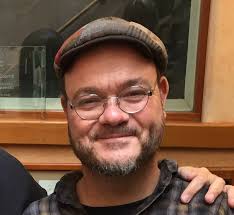
On October 16, 2025, Mitch Jeserich bid listeners “Goodbye and Thank You,” ending 16 years of KPFA’s Letters and Politics and 26 years of reporting for KPFA in San Francisco.
This was not a retirement.
Jeserich had already begun reaching out to listeners with a new podcast and new Substack publication, Letters from Mitch.
These are fresh mediums of correspondence for Jeserich, contemporary ways to connect.
On November 11, 2025, I spoke with Mitch about his work at KPFA and Pacifica, about his new pursuits, and about the value of story-telling.
This interview has been edited for length, clarity and sequence.
Diane Reinhardt
First, Mitch, congratulations on your new work and thank you for the programming that you’ve done.
Let’s start by talking about Letters and Politics. I realize you’re still perhaps too close to leaving to look back with an objective eye on the work. But I imagine you know from the scope of your work and from listeners that the 16 years of programs encompass a breadth and depth of the world’s thinking, not only about current affairs, but about current affairs in the context of the timeless, touching philosophy, science, literature.
So I’m wondering, even in this little bit of time, what stays with you…what interviews, what discoveries, what people?
Mitch Jeserich
Well, first thank you for saying that. All of that’s meaningful to me.
It is a strange, liminal state, yes; and, as you indicate, it hasn’t been that long since I left. So I really haven’t reflected about the show itself, or the programming, which I was dedicated to and which was very much a part of how I existed and saw myself in the world. But what I reflect more upon are the people I knew and the interactions I had.
I learned the most important thing about radio right at the end. I got a deeper sense of what it means to connect to the audience. That’s [what] was really driven home to me.
I began announcing that I was leaving on-air the first day of the KPFA Fall fund drive because I didn’t want to mislead listeners, to ask them to donate and then not be there a few weeks later. I still thought it was really important for them to donate; so, I also let people know that I wasn’t just going to go away.
I started to get notes from listeners. It wasn’t in the thousands; it wasn’t even 1,000. But it was several hundred. And one after another was someone expressing sadness that I was leaving.
I wasn’t prepared for that. It made me feel sad too. I don’t regret leaving, but I felt the sadness. At first, I intended to respond to every note, but I didn’t want to flippantly respond. I wanted to say, in a sentence or two, something meaningful back.
But then they just piled up; and so I never responded to any of them, not because I didn’t care, but actually because I did. It taught me about the connection that the listener has to a radio station and has to who they listen to, especially if they listen to them frequently, regularly.
I realized that there was a bond breaking for them. People had a routine of listening every day. That’s what they did. I heard a lot from Los Angeles and the San Francisco Bay Area, throughout California. I heard from people around the country who listened on affiliates. There’s an emptiness there. You get over it. Listeners will get over it, but you feel it. You feel it.
That was a huge lesson to me as a broadcaster, whether it be on radio or podcasts. As a broadcaster, you form a bond with your listener, and that bond is actually more important and more sustaining than
probably anything else that you’re doing. Not that the other things aren’t important. They are. But I think sometimes it’s easy to forget about that bond that we have with the listener, and this experience of leaving really drove that home for me.
Diane
Your sixteen years of programming included conversations about the work of a wide range of contemporary authors and also a fair number of series about ancient cultures and the evolution of philosophic and political ideas. And that content, I would guess, strengthened that bond.
Mitch
This was part of [my listeners’] routine every day, but they did it because they thought they were going to learn something. It wasn’t just the show that made people think of it as a place for lifelong learning. But I would actively say that during fund drives.
There are lots of people in the world who see their lives as this journey of learning, and it’s important to them. I’m not the number one rated show in the Bay Area. It’s not like I had a huge audience. I didn’t. I never did. I had a very little small audience. And I would see the same names pop up every time I would ask for a donation, multiple times in the same drive. And, I think, for them, they were kind of like on this journey.
Diane
So, let’s go to what has to be the follow-up question: Why did you decide to end the series?
Mitch
There’s no one reason. It’s an accumulation of reasons that combined to create this decision of ‘now is the time.’
One being I did find it harder to do; and I always told myself, if I couldn’t give it my all, I’m not going to do it.
But that’s not the big reason. There are other things I want to do, and I feel as though, at the age I am now, at 53, that, if I didn’t do it now, I would never do it and maybe it was already too late to take a leap. That’s why I object to the term retirement.
And that blends into the third reason, and not everyone agrees with me on this and I’m okay with that disagreement, but I feel like radio is dying. I don’t know if it’ll ever die, but there are just fewer and fewer people who even own a radio.
Now, there are podcasts, and you can get most of, maybe all, these radio stations online; but I feel like [radio is] kind of lost online. On the airwaves, our stations are very unique. You won’t hear anything else like KPFA on the radio, at least in the Bay Area; but you will find really progressive, lefty news and analysis online in a lot of other places. So, while I feel like we still stand out on the broadcast dial, we kind of get lost online. We were late making an impact on the internet.
Radio is still really important to us–[KPFA] is still distinguishable and really important and worth listening to–; but I don’t know very many young people who own radios. Most of our audience is getting older, is older. And I think that we see that year in and year out in our listening statistics, our fundraising numbers. We’re still able to pay the bills, kind of impressive, and to have some paid programmers. I think one of the reasons we are still able to pay our bills is that so many of our listeners have actually put us in their wills. We’ve got some big bequests that have kept us on the air.
But we still see our numbers dip almost every year. Trump gets elected. That might give us a bump, but the overall trajectory is going down.
There are also more reasons that play into this. I think media is part of our problem, which is not new. I feel like media has driven people to hate each other. I think we play a role in the problem with everyone’s quick take to define realities.
And I feel like I’ve played a small role in that, and I don’t want to play a role in that anymore. So, this is coupled with my previous reason of leaving while I can. I didn’t want to be in a situation in which I was trying to stay at the radio station, to hang on for as long as I could, hoping it could get me to retirement. That wasn’t the kind of existence I wanted to have.
Diane
And, so, I know that you’ve started a podcast, you’re posting on Substack, and you identify yourself there as “a career public broadcaster.” It’s a different kind of broadcasting. What do you know about your plans in these new mediums?
Mitch
I don’t know what it will be. I’m not saying I’m getting out of media, but I do have an ambivalence of [wondering], a podcast, Substack, what do they become?
I’ve got some of my own stories that I would like to tell. For years, I have been telling other people’s stories and learning a great deal; and, through that, I feel like there are perspectives that I want to share. So, I am embarking on this storytelling project; but I don’t know what it will be.
Once I became unemployed, I [thought] I better implement some good habits right now. So, I forced myself to write every morning for a couple of hours right after breakfast. But, boy, I really struggle with it. What I’m writing becomes something else, and then becomes disjointed. I’m not struggling to actually write, but I’m struggling to have a coherent piece that I’m comfortable putting out there to the
world.
So, right now, I’m at the point where I just quit a long time job and I’m throwing myself to the Universe, and what’s going to happen is going to happen. I’m trying to be open to it. Whatever this work turns into, it will turn into, sustaining or not.
Diane
I think these questions are probably recognizable to anyone who has left a long time job, the sense of challenge, uncertainty, anticipation, the experimentation of those early months, seeking definition.
So, maybe, this is a good time to look back to the time before Letters and Politics. What is the history of your connection to community radio and to KPFA? What brought you to journalism, and why did you stay?
Mitch
What brought me to KPFA was the big [local control] war of 1999, the internal Pacifica war when Pacifica was considering selling KPFA. It caused havoc.
I had listened to KPFA before, when I was in college. Jerry Brown, our former Governor, used to have a show on KPFA called We The People. And I also listened to another great show still on KPFA called Over the Edge.
And then, came the shutdown, the lockout at the station. A friend said, ‘Hey, let’s go check out the protests from Berkeley.’
It was the first time I’d been to KPFA. It was really shocking. There were hundreds of people that had just completely shut down the street that KPFA was on. There were tents in the street. There were people in sleeping bags at the front door. It was just this real, organic thing. So many protests feel like what they really are, press conferences in disguise. But that’s not what this felt like. It felt like a real serious movement.
And, then a few days after that, they won. They were let back in, and they saved the station. There was a huge celebration. 10,000 people showed up. It was just amazing. I couldn’t believe it.
So, I went to work the next day. I was a community organizer at the time in San Francisco. This is early internet, and KPFA had an internet page. I went to their page, and I saw that they had a News Training program that was taught by Mark Meracle, a longtime KPFA news anchor and director.
I applied for that program, and I got in. And that very first day of class, I was like, ‘Yeah, this is for me.’ [Mark] had us read a [pre-written] script for the news that he was going to record. And he said, ‘Whoever reads the best script, I’m going to air it tomorrow morning on the news.’ And, lo and behold, it was my script, which is funny, because, when I look back, I sounded like a professional wrestler, really uptight, intense. But it was my script. I read the one that played as a short news headline, and I loved
it immediately. I knew right then, this is what I’m going to do.
Diane
And that inspired the creation of Letters and Politics?
Mitch
So, [there’s] a little more backstory. I worked as a volunteer at KPFA for a couple of years, and I got to do some really amazing stuff. A radio station allows you to do some pretty cool stuff if you’re willing to take the initiative. And I was. I was a volunteer reporter for the News Department; and then, in 2001, the Zapatistas in Mexico did this march from Chiapas to Mexico City to demand Indigenous land rights. I went on it with them, and it was this magical experience. I got a lot of tape and made a documentary.
Then, a news reporter job to cover the State legislature in Sacramento opened up. I had, as a community organizer, a lot of experience with State politics, and I got it. I loved being a journalist, and I dove head first into it. Then, after doing that job for about a year and a half, a gig opened up in Washington, DC for the Capitol Hill–Congressional, White House and Supreme Court–correspondent for a news program called Free Speech Radio News. It no longer exists, but it used to serve as the
Pacifica Network’s national news program. So, I became the DC correspondent for three years, and that opened up a lot of doors within the network for me.
After that, I went to New York to work with another former Pacifica person, a great broadcaster, Deepa Fernandes, who was at WBAI at the time. Then, in late 2007, KPFA recruited me to come back, and I was ready to come back, back to the easy life in California. I always knew I wanted to host a show; but
I first came back to produce the KPFA morning show. I got a lot of experience for the next couple of years.
And then Obama got elected; and I proposed doing a pilot project called Letters from Washington. I’d go back to Washington, DC and cover the first 100 days of the new Obama presidency, like the whole idea of FDRs first 100 days. It was just a 20-minute pilot program that was aired on the morning show.
Every day, I would begin each program by saying, ‘Welcome to Letters from Washington. Today’s day three of the first 100 days.’ But, once listeners saw the writing on the wall that the program was probably going to be over at the first 100 days, emails, notes and letters and phone calls started coming in, not to me, but to the General Manager. It was something I’ve never seen before because it wasn’t organized. I wasn’t asking people. This was all happening on its own.
And so the management decided to turn it into a daily program. It was called Letters from Washington, but I didn’t feel comfortable saying Letters from Washington once I was in back Berkeley. So, I changed it to Letters to Washington.
At first it was really not different from Democracy Now, but with more of a DC heavy focus. I was able to cover breaking news from DC. I was on this for a couple of years until I got really exhausted. I got tired of talking about events that wouldn’t be relevant a few days later. How often do we go back to listen to a newscast from three weeks ago? Never. I wanted something that had more merit, and education has always been important to me. I’ve always loved public broadcasting because I am a lifelong learner. I always knew what I wanted to do was what Bill Moyers did with Joseph Campbell and The Power of Myth.
And the great thing about Pacifica is there’s not someone looking over your shoulder telling you what you have to do. So, I was able to change the show into something that I think was actually kind of unique. I changed the name again because Letters to Washington felt a little more advocacy-based than I wanted it be.
The Letters and Politics name actually has a lot of meaning for me. Letters was always there, and it’s still there, even in this new podcast. It’s a complete rip off from the old BBC broadcaster Alistair Cook from PBS. He had this wildly popular five minute audio essay show every day called Letters from America. I remember seeing a PBS documentary about it many years ago, and I just fell in love with it. So the original pilot project name was Letters from Washington.
Diane
And you’re staying with Letters for your SubStack and your podcast, Letters from Mitch.
Mitch
Well, the Substack is just my name. But the podcast is called Letters from Mitch. I am oscillating between that and Story Time with Mitch. Inevitably I want to tell stories, not just stories about me, though they will be personal. I like telling stories too from history. I like being able to tell the story but to also talk about the historical context. I got to do this during fund drives at KPFA.
I did a series on the History of Ancient Democracy. I enjoyed that, but it was a lot of work. I spent weeks, if not months, in advance, diving in, learning everything I could. Oftentimes, I would take vacation time just so I could do it. I would travel to places whose stories I wanted to tell, to get this tactile, experiential feel. And I loved it. That’s what I want to do. What I want to do takes more outside work than what you actually end up producing for outward consumption.
Diane
These next steps feel like both a natural extension and expansion of what has been until now your life’s work, a commitment to public media that evolves as the medium evolves.
Mitch
[Earlier,] I painted a very bleak picture about the future of radio, but I don’t want to be so determinative about it. I am a nihilist. The news seems to prove me right every day. My universal view is that one day the sun’s going to expand and blow up, you know.
[But] I don’t think it has to be gloom for radio. I do think, as we enter more and more every day this digital-dominated world, especially now that we’re at a sort of crossroads on the horizon of Artificial Intelligence, that we’re going to see a resurgence in people wanting something human again, something that goes back to that bond that listeners form with somebody that they like on the air because they see them as their friend. That’s what people told me in their notes: ‘We’ve never met, but I always thought of you as my friend’
And I’m kind of wowed by young people today who aren’t impressed with technology and seem to be more concerned about being human again. I have seen some young people who say, ‘Yeah, I want to farm.’ Wow, that’s really interesting to me. Technology is going to be with us, but there’s also going to be this rebellion against it, too, people who want something not digitally created or digitally enhanced or originated from a digital process, but that has a human element to it.
And, of all the mediums out there, radio is the most human of all, especially when it’s live, when it’s just the voice of a person. As a broadcaster, you are trained to think that you’re talking to just one person; and so, I think, if some things break our way, and, if done right, there could be a second wind, another go, another appreciation for radio again. I do think it’s possible. The nihilist in me says that it won’t happen, but I’m trying to regulate myself.
Diane
I think you’ve identified radio’s core strength. There’s an intimacy in the human voice, maybe even greater when there isn’t a visible body, when it is simply a voice talking to you. That’s what you did for listeners with Letters and Politics and why they’ll miss you.